Two things:
First, Governor Deval Patrick of Massachusetts has launched a new campaign called Mass in Motion, aimed at trimming the waistlines of Commonwealth residents. The plan will require fast food outlets to post calorie counts for the items on their menus. It mirrors programs in place in California, New York City, and Seattle.
The usual clique of libertarian commentators has generated a mild uproar in response to Patrick's worthy proposal. I scoff at their self-righteous stance, for as a borderline underweight resident of the Commonwealth, data posted on the menu will enable me to accurately choose the most caloric item and forstall my slide into emaciation. Fast food establishments will easily offset the tens of thousands of dollars lost to laboratory calorimetric tests by weight-conscious beanpoles' deliberate purchases of the most lard-laden, high-priced concoctions on the menu. I thank the government for safeguarding my hard earned body mass.
Second, a 13-year-old in Orange County texted 14,528 times in one month, or about 484 times a day, or about 30 times an hour, or about once every two minutes. Since this girl spends so much time text messaging, one wonders what those messages could possibly concern. She has no time between messages to generate new topics for communication, unless she's a prolific liar, so she must receive other peoples' messages and immediately relay them to the next recipient in a chain of gossip. This girl is the proverbial grapevine.
Even more surprisingly, the average 13- to 17-year-old text messages 1,742 times a month, or about 58 times a day, or about two times an hour. I imagine that a high proportion of 13- to 17-year-olds are barely literate, since they have no time to read between opening and chuckling at messages received every two minutes from that girl in Orange County. Their quasi-English syntax is constructed from "phononyms" and acronyms, they have no grammatical knowledge, and since they text message instead of communicating aloud even within earshot of the message's recipient, they have no concept of pronunciation. I had better start learning cell-phone English before verbalization ceases in 2012, or else I'll be talking to the void. This post is good practice for the more likely fate.
Monday, January 12, 2009

Monday, December 29, 2008
The Best of Valentine Dining Hall
Given the name and the writers of this blog, you'd think there would be more posts about Valentine Dining Hall, the dining hall of Amherst College. Yet, when we initially launched this blog, Miller and I had very broad ambitions. We wanted a global audience--not one confined to the hills of Amherst, and so we tried to take on topics that wouldn't be Amherst specific (i.e. the top five cereals of all time or the evolution of klezmer music).
Nonetheless, with a dwindling readership, it is time to briefly pander to the Amherst College crowd. To our readers elsewhere, I apologize.
And so here are the top five meals at Valentine Dining Hall. What is a meal? Something that is not offered everyday--so anything that can be made on the stir fry or panini press on a daily basis is not eligible. And what makes a good meal? Something that makes you forget the dreadful assignment waiting in your dorm or forget the test you just bombed. Something that you come across on the internet menu days in advance, and excites you so much that you scream to other people about it. And in some cases, something that most people don't like but you do, so you can get it quickly without waiting in a long-line.
5. Chicken Gyro
This has been a welcomed new addition to the Valentine menu. So long as you don't worry about how much the chicken had to be processed to take on its odd shape, the chicken gyro is an excellent lunch selection. The bread can even be eaten by itself, if meat's not your thing. There may be some panini potential here too--I have not tried it yet.
4. Salmon with Asian Sauce
Due to the efforts of a few, many have suffered. Salmon with Asian sauce is no longer offered at Valentine, but when it was, it was great. You could put that sauce on anything, and it would be good. When students complained about the name, rather than simply relabeling the sauce, the dinning staff has looked to alternatives. While good, they do not match the unique blend of Asian sauce.
3. Thanksgiving
Thanksgiving is my favorite holiday, and Valentine Dining Hall celebrates it pretty much every other week. More than anything on the list, this a complete meal. From the turkey, to the stuffing, to the weird veggie mush, to the all important corn bread, you cannot go wrong. The white cake, I mean corn bread, is a day-changer.
2. Crepes Stuffed with Mushroom and Spinach
In general, I think the dining staff goes a bit overboard with the vegetarian options. Always, at the end of the food selections, there is some extravagant vegetarian entree with more ingredients than I can count. Yet, when the dining staff keeps it simple, they excel. Case in point--the vegetarian crepes. I will cut the lines for these.
1. Lasagna/Ravioli
Before coming to Amherst, I never had a proper introduction to Italian food. This was due in large part to my fear of cheese. For example, up through middle school, I only ate cheeseless pizza. However, thanks to Amherst's lasagna and ravioli, I am gradually coming out of this shell. No two menu items perk up my day the way lasagna and ravioli do. As an additional perk, lasagna is almost always served on the same day as chicken fingers, which means the line isn't too long.
Honorable Mention: Turkey Croissant Sandwiches (great on the panini press)
Discuss.
Wednesday, December 24, 2008
I Can't Put My Arms Down!
And so it begins.
Last year, I said everything that needs to be said about A Christmas Story. All I will say now is make sure to watch it. It starts at 8 tonight and goes for 24 hours.
Last year, I said everything that needs to be said about A Christmas Story. All I will say now is make sure to watch it. It starts at 8 tonight and goes for 24 hours.
Year in Ideas, 2008
Last year on the VD, I wrote about my favorite magazine issue of the year: The New York Times Magazine Year in Ideas. Now, I am going to write about this year's issue, though it is far from my favorite magazine of the year. For whatever reason, this year's Year in Ideas is not that interesting. Maybe my tastes have changed or maybe the shrinking ad revenues have really hurt the Times, but either way, I got through this year's issue much faster than normal, since I barely looked at some of the ideas.
Nonetheless, some were still interesting and here are my favorites:
Avian Dancing (pg. 42): It is always a bit upsetting to be on the outside of a YouTube Viral Video. For example, earlier this year, someone showed me this fantastic YouTube of OK Go Dancing on treadmills. I subsequently forwarded the YouTube along, only to be told that I was years late. If over 40 million people have viewed a YouTube before you, then you are clearly out of it. What does this have to do with the NYY mag?
This idea details a YouTube viral video I was also unaware of: Snowball the Dancing Cockatoo.
Pretty unremarkable. At least that's what I thought. However, Aniruddh Patel, senior felow at the Neurosciences Institute in California, thinks otherwise. Apparently there's been an ongoing scientific argument over the evolutionary benefit of dancing. Dancing, according to some scientists, serves a purpose greater than creating awkard encounters. It in fact "confers survival benefits through group bonding." To that end, according to the magazine, dancing should only be seen in animals with a long history of dance and music. And so the fact that Snowball was dancing seems to cast doubt on this theory, given the fact that birds do not have a history of dancing.
Patel did tests on Snowball with different songs and speeds, and showed that the bird really does "indicate sensitivity to the beat and ability to synchronize with it."
That some random video posted by someone of their bird dancing led to such scientific inquiry is amazing. That a scientist is actually playing music to a bird, to see if it can dance, is even more incredible.
Bubble Wrap that Never Ends (pg. 47): A couple years ago, my town got its hands on a tremendous amount of bubble wrap. Not sure how or why, but I am proud to say they use d it in the best way possible: my town sponsored a "Bubble Pop Hop." Everyone in the town was invited to the town center, to jump, tumble, and roll on the bubble wrap. It was beautiful.
And that's why I was so excited to read about Japan's Mugen Puchi Puchi ("Infinite Pop Pop), a battery-powered chain that simulates poping a bubble of bubble wrap. The key-chain's bubbles rebound, resulting in endless pleasure.
This does pose an interesting quandary, though. Is part of the charm of popping bubble wrap that it has limits? That you can only do it when someone sends you a package and only before you run out of bubbles? That is the Vegan Dessert Question of the Day. Discuss.
Eat Kangaroos To Fight Global Warming (pg. 55): Cows fart a lot of methane. And that is not good for global warming. With a GWP of 25 over 100 years, methane is far more potent greenhouse gas than is carbon dioxide. And that is why George Wilson of Australian Wildlife Services thinks that more people should be eating kangaroos. Kangaroos, it turns out, do not fart like their cow counterparts, and they don't taste all that bad either. And so replacing cows with kangaroos would play a part in delaying the destruction of the Earth via global warming.
The Spray on Condom (pg. 72): No explanation needed.
This is the first of what I hope will be several year-end VD posts. I hope you are hungry for more.
Nonetheless, some were still interesting and here are my favorites:
Avian Dancing (pg. 42): It is always a bit upsetting to be on the outside of a YouTube Viral Video. For example, earlier this year, someone showed me this fantastic YouTube of OK Go Dancing on treadmills. I subsequently forwarded the YouTube along, only to be told that I was years late. If over 40 million people have viewed a YouTube before you, then you are clearly out of it. What does this have to do with the NYY mag?
This idea details a YouTube viral video I was also unaware of: Snowball the Dancing Cockatoo.
Pretty unremarkable. At least that's what I thought. However, Aniruddh Patel, senior felow at the Neurosciences Institute in California, thinks otherwise. Apparently there's been an ongoing scientific argument over the evolutionary benefit of dancing. Dancing, according to some scientists, serves a purpose greater than creating awkard encounters. It in fact "confers survival benefits through group bonding." To that end, according to the magazine, dancing should only be seen in animals with a long history of dance and music. And so the fact that Snowball was dancing seems to cast doubt on this theory, given the fact that birds do not have a history of dancing.
Patel did tests on Snowball with different songs and speeds, and showed that the bird really does "indicate sensitivity to the beat and ability to synchronize with it."
That some random video posted by someone of their bird dancing led to such scientific inquiry is amazing. That a scientist is actually playing music to a bird, to see if it can dance, is even more incredible.
Bubble Wrap that Never Ends (pg. 47): A couple years ago, my town got its hands on a tremendous amount of bubble wrap. Not sure how or why, but I am proud to say they use
 d it in the best way possible: my town sponsored a "Bubble Pop Hop." Everyone in the town was invited to the town center, to jump, tumble, and roll on the bubble wrap. It was beautiful.
And that's why I was so excited to read about Japan's Mugen Puchi Puchi ("Infinite Pop Pop), a battery-powered chain that simulates poping a bubble of bubble wrap. The key-chain's bubbles rebound, resulting in endless pleasure.
This does pose an interesting quandary, though. Is part of the charm of popping bubble wrap that it has limits? That you can only do it when someone sends you a package and only before you run out of bubbles? That is the Vegan Dessert Question of the Day. Discuss.
Eat Kangaroos To Fight Global Warming (pg. 55): Cows fart a lot of methane. And that is not good for global warming. With a GWP of 25 over 100 years, methane is far more potent greenhouse gas than is carbon dioxide. And that is why George Wilson of Australian Wildlife Services thinks that more people should be eating kangaroos. Kangaroos, it turns out, do not fart like their cow counterparts, and they don't taste all that bad either. And so replacing cows with kangaroos would play a part in delaying the destruction of the Earth via global warming.
The Spray on Condom (pg. 72): No explanation needed.
This is the first of what I hope will be several year-end VD posts. I hope you are hungry for more.
Thursday, May 22, 2008
Pro-Choice?
 Almost everyday at Valentine, before I take my requisite bowl of Kashi Heart-to-Heart, I head over to the pizza station and survey the scene. I like to see what ridiculous creation is on tap for the day. Potato pizza? Pineapple, pepper and pepperoni? Chicken and pesto? How about plain cheese pizza?
I am generally completely overwhelmed and do not take any slice to eat. In fact, this semester, I had one piece of Valentine Pizza. There are so many outrageous creations, and I can't decide which one to eat, so I end up eating nothing.
This paradox led to an interesting Valentine conversation with the basic question: is choice a good thing? Would the pizza guy be better off sticking to 2-3 regular, solid, predictable flavors as opposed to 8-10 seemingly random concoctions. Would I consume more of his product if there was less of it?
Barry Schwartz, a sociology professor at Swarthmore College and author of The Paradox of Choice, would probably tell the pizza guy to slow down and stop making so many freaking flavors. An Amherst student showed me a YouTube clip of Schwartz talking about choice (see below for clip). In it, Schwartz lists out the four negative consequences that have arisen from the overabundance of choice:
1. Regret and anticipated regret--If the product is not perfect, then you instantly wonder what could have been. Thus, before you make a decision, you are met by a sort of paralysis, rather than a liberation since you don't want to mess up and feel regret later on.
2. Opportunity Costs--As alternative options have become more attractive, the opportunity costs to decisions have gone up.
3. Escalation of Expectations--You expect perfection; anything less, and you'll be left disappointed.
4. Self-blame--With limited choices, if a product is bad, the honus goes on the producer. Today with so many choices, if a product is bad, the honus goes on you, because you could have chosen something better. Thus you get sad and depressed for your stupid decision.
"There's no question that some choice is better than none, but it doesn't follow from that, that more choice is better than some choice," said Schwartz. Adding, "We have long since past the point where options improve our welfare."
Instead, too much choice has created a "recipe for misery and disaster" according to Schwartz.
What should we make of this world of seemingly unlimited choice, where 10 different cereals, pizza flavors and drinks are offered to us each day at Val? In certain cases, as with the pizza, I simply don't make a decision. In other cases, as with the cereal and drinks, I use habit to defeat the overwhelming grasp of choice. I eat the same cereal/drinks every meal, and establish a comfort zone. Others simply mix five drinks or cereals together at one time so they don't have to make a decision yet they still don't starve.
"The secret to happiness," according to Schwartz, "is low expectations." With this in mind, maybe I'll finally try one of Mr. Pizza's crazy creations tomorrow at Val.
On second thought, I think I'll probably stick to my Kashi and Turkey Sandwich. I wouldn't want to stray too far away from my habits with just a few days left here at Amherst.
Tuesday, May 20, 2008
Puff Daddy Agrees: Hip Hop is Not Dead
Puff Daddy aka P. Diddy aka Diddy aka Sean Combs apparently had an experience similar to my own at Kanye West's Glow in the Dark Tour. Watch this video to see what I mean:
Saturday, May 17, 2008
The Biggest Star in the Universe? Probably
 "I love this shit, because I own this shit."
It took nearly an hour of non-stop performing before Kanye West finally talked to the audience at last night's Hartford stop of his Glow in the Dark Tour. And the man spoke the truth--he does own the music world.
Following shorter segments by Lupe Fiasco, N.E.R.D., and Rihanna, Kanye went on an over hour long space traveling hit parade, touching on every major chart he's ever had. He was at times thrilling, inspirational, and egotistical. Throughout, he was freaking amazing.
Following shorter segments by Lupe Fiasco, N.E.R.D., and Rihanna, Kanye went on an over hour long space traveling hit parade, touching on every major chart he's ever had. He was at times thrilling, inspirational, and egotistical. Throughout, he was freaking amazing.
With spaceship "Jane" there to guide him along, Kanye went on a bizarre trip through the Universe, filled with crash landings and shooting stars. It was at times depressing to see hip-hop's biggest star talk to a make believe space ship, but overall, the space theme added much to the set, including some wit and theatrics.
Kanye sang the new stuff--"Stronger," "I Wonder," "Flashing Lights..." The old stuff--"Gold Digger," "Diamonds are Forever," "Jesus Walks." And the unexpected--"All Falls Down," "Spaceship," and even "Don't Stop Believing." Every song was tinkered with for the live-concert, some more than others, to infuse them with a remarkable energy that kept the audience hopping and asking for more.
The highlight and climax of the concert was undoubetdly "Stronger," though "I Wonder" came in a close second. In both, Kanye's terse lyrics were clearly audible amid the chaos of screaming fans, blaring backgrounds, and impressive pyrotechnics.

The only down moments of the concert were "Get Em' High" and "All Falls Down," when Kanye went a bit overboard with the live-concert changes. When it takes you 30 seconds to realize what song is being played, that's not a good thing. But these were just minor flaws in a set that managed to touch every single big hit I wanted to hear ("Roses" would have been nice, but I realize it's a little to slow and depressing for a live concert.")
I'm pretty sure the rest of the concert was good, though my memory of everything before Kanye has been kind of scrambled. Lupe opened the concert with a short, sweet set. Though the seats were mostly empty, Lupe's goofy style connected with those who were there.
N.E.R.D. was simply LOUD. Every song sounded pretty much the same, as dueling drums covered up anything Pharell tried to sing. "Spase" was one of the craziest, psychedelic songs I have ever head, but other than that, N.E.R.D. did little more for me than destroy my hearing.
I was more anxiously awaiting Kanye than listening to Rihanna during her set, but the screaming girls seemed to like her. "Please Don't Stop the Music" was the highlight for me. "Umbrella" could have gone on a little longer, and it was really bothersome that the dancers never opened up the Umbrellas they were dancing with. I also didn't know Rihanna sang the "Come Mr. D.J." song, so that was cool.
Yet, the first acts could have been trash, and this still would have been the greatest concert I've ever been (note: I've been to very few concerts, but even if I'd been to a hundred, I'm pretty sure this would hold true). The "Glow in the Dark Tour" was not merely a concert, it was a spectacle.
Kanye West is not one to hide his greatness, and for that I am grateful.
"If this concert is rated B, then I want to know what is a fucking A."
So do I Kanye, so do I.
Wednesday, January 2, 2008
Good, Just Not my Taste
 Eh.
I'm not sure I've ever heard Ebert and Roeper use that word to describe a movie, but it's how I felt after seeing Juno yesterday in theaters. The movie was entertaining enough to keep my attention, but it was not memorable. It was an artsy, rebellious version of Knocked Up, and it didn't hold up in comparison.
The movie revolves around independent-minded 16-year-old Juno Macguff (Ellen Page) who gets pregnant with unemotional, undeveloped, uncool Paulie Bleeker (Michael Cera). At first she considers abortion, but eventually decides to have the baby and give it up for adoption. Over the course of the film, Juno must deal with all sorts of issues--with Bleeker, the adopting family, and herself--which constantly put the fate of the unborn baby into question. Will she keep the baby for herself? Will she find a different family for adoption? Will she split apart the adopting family?
All of these questions swirled through my head and led to an incredibly awkward viewing experience. The resolution to the questions is underwhelming. The movie begins to head down one track, and then all the sudden veers in another direction, without much transition in between. I know that's very vague, but I don't know how to write movie reviews, and I don't want to give away too much.
I suppose the main reason for my tepid review of Juno is that the previous two comedies I've seen in theaters are
 Knocked Up and Superbad. They were both two hours of penis jokes, McLovin, and tear-inducing laughter. They were in-your-face comedies that still managed to get a message across. Juno fits into a different category. It's a romantic comedy that's far more subtle. For some, this might be preferred (Juno has gotten rave reviews). But for me (a male teenager), it takes a backseat.
Ellen Page as Juno is fantastic. She is incredibly believable, and some how manages to conquer the complexity of her character. On the other side, Michael Cera as Bleeker is as uncomplex as possible. How many more movies can Cera possibly do? In life, there are certainly people that are emotionally vacant, but in a movie, such characters can get tiring.
If romantic comedies are you're thing, definitely go ahead and see Juno. But if you want to laugh-up the meal you just ate, go rent Superbad and watch it at home.
Monday, December 31, 2007
The Cauceyed State
 This Thursday the Iowans caucus. That arcane communal ritual may decide who squares off in the November presidential elections. Most of the candidates have focused on winning the Hawkeye state. All of their destinies hinge on the outcome.
Those candidates who did not establish an early lead in Iowa faced two fates: stagnation or surge. Initially undecided Democratic caucusgoers have sided with the three initial frontrunners -- Obama, Clinton, and Edwards. Richardson, Dodd, Biden, and the other trivial candidates have stagnated at minuscule percentages in the polls. The lesser candidates of both parties must envy Huckabee, who has experienced a remarkable surge since October. He has probably attracted the values-voters who might have supported the bygone campaigns of Brownback and Tancredo. And after Thompson's lackluster start, it was easy for an evangelical Southern candidate to pick up steam as an alternative to Romney, the flop-flipping heathen from Massachusetts.
Although Huckabee stands a few points ahead of Romney in the most recent poll, his recent gaffes could catch up with him by Thursday. The floating cross campaign ad suggested that under Huckabee's upright facade lies a cancerous growth of Clintonian insincerity. Supporting evidence for this possibility came on Monday, when Huckabee held a press conference claiming that only 30 minutes earlier, in the spirit of clean-handed politics, he had decided to pull a TV spot attacking Mitt Romney. Huckabee proceeded to air the ad on a projector, in effect broadcasting it free of charge via journalists. To peals of laughter from the audience, Huckabee insisted that it was essential to show the ad in front of the hypercynical media to prove that it existed in the first place.
If Huckabee takes Iowa, he'll be a shoe-in in South Carolina. Romney wins Iowa in the event of a Huckabee loss. The resultant windfall of publicity could propel Romney over McCain in New Hampshire, in effect deciding the nomination. McCain is currently polling in single digits in Iowa -- he needs a big assist from Huckabee.
An article in the Times discusses the possibility of an inconclusive result in Iowa. Among the Democrats, a neck and neck finish between the three top contenders would throw Edwards a life raft. He could go on to victory in South Carolina, assuming that he doesn't lose too badly in New Hampshire and Obama doesn't rally the entire black vote behind him. An inconclusive result probably disfavors Obama, who would split the radical liberal vote with Edwards in Iowa and then New Hampshire, thereby guaranteeing Clinton's victory. Obama needs victory and a clear Edwards defeat in Iowa to contend with Clinton in New Hampshire. If Clinton blatantly loses in Iowa her game could be up in New Hampshire.
The consequences of an equivocal Republican result in Iowa could be even more convoluted. National poll leaders -- McCain and, until recently, Giuliani -- obviously benefit from a near tie between Huckabee and Romney. If that situation allows McCain to handily take New Hampshire, Giuliani's investment in the later primaries would probably yield paltry returns, since Giuliani and McCain seem to derive support from similar constituencies.
The unprecendented amount of money flowing into the Iowa campaign means that a stalemate among the candidates could be considered a devastating loss of resources. Although Iowa might have marginalized its political significance by caucusing absurdly early, either a stalemate among candidates or checkmate by any one candidate in the Hawkeye state will determine the course of events in the rapid succession of primaries that follow.
Sunday, December 30, 2007
Year in Ideas
 I have spent the past three weeks reading the best magazine issue of the year: The New York Times Magazine Year in Ideas. Little by little--during meals, before bed, in between finals studying--I have made my way through the issue, which lists the innovative, bizzare, and sometimes ridiculous "ideas" that emerged this past year.
Many magazines have December issues in which they detail the technological innovations of the year. What separates The New York Times Magazine rendition is that it is not simply devoted to technology. It is far broader and less concrete. Some of the "ideas" are technological innovations, but others are abstract concepts on subjects ranging from sports, to politics, to relationships.
I could probably do a blog post for almost every idea. However, instead I will simply list my favorites:
-Craigslist Vengeance (pg. 62): In March, a vengeful niece placed on ad on Craigslist, inviting all readers to come to the home of her aunt and "take what you want. Everything is free. Please help yourself to anything on the property." Though the ad was up for less than 2 hours, the aunts house was stripped bare--even the front door and kitchen sink were taken by a rabid bunch of Craigslisters. With the enormous readership of The Vegan Dessert, who knows what sort of vengeance I could achieve?
-Electric Hockey Skate (pg. 68): Since I have recently committed myself to getting good at ice skating, this one was particularly interesting. Some guy from Calgary has designed an ice hockey skate with a heated blade. The heat is not meant to warm the skaters foot, but rather to melt the ice below. By melting the ice, the ice skate faces less resistance and allows the skater to move faster. Several NHL players are trying out the skate. Seems kind of unfair to me. Some sort of regulation has to be put in place to set a limit on skate temperature.
-Left-Hand-Turn Elimination (pg. 80): Who doesn't hate left turns? They're stressful, waste time, lead to accidents, force you to turn down the radio volume...According to the NYT Mag., U.P.S. really hates left turns. U.P.S. has a fleet of 95,000 delivery trucks, and each time a truck must wait to make a left turn, it wastes gas and thus money for the company. To save cash, U.P.S. employs a computer program that maps out every delivery route and seeks to minimize the number of left turns, while taking into account the added distance that results from the extra right turns. Last year, the computer program saved close to 3 millions gallons of gas for U.P.S.
-Smog Eating Cement (98): This one had a special place in my heart because I actually understood some of the chemistry involved. An Italian Company produced cement with titanium dioxide in it. When exposed to light, the titanium dioxide can oxidize nitrogen and sulfur oxides (which make up smog) to the less hazardous nitrate and sulfate forms. The concrete has been proven to significantly clear up smog--pretty cool.
-Vegansexuality (103): I saved the best for last. Though I am not vegan or even vegetarian, I do for whatever reason write on a blog called The Vegan Dessert, so this idea has to some how relate to me. According to a survey conducted by a researcher at the University of Canterbury, some vegan eaters are rather reluctant to have carnivores as sexual partners. "I couldn't think of kissing lips that allow dead animal pieces to pass between them," said one respondent. "Nonvegetarian bodies smell different to me," said another respondent, "They are, after all, literally sustained through caracsses -- the murdered flesh of others." Maybe if I just eat vegan desserts along with the meat, I'll smell alright for vegansexuals, veggiesexuals, and carnosexuals.
Saturday, December 29, 2007
Gameday
 If you somehow haven't heard, you can watch the Patriots play the Giants tonight at 8:15 on the NFL Network, CBS, NBC, My Nine, MTV, TBS, Comedy Central, the Discovery Channel, and Lifetime.
Also, if you haven't heard, the Patriots are 15-0. If they win, they will be the first team to ever go 16-0. The Giants are 10-5. They have absolutely nothing to play for in terms of playoff seeding. The coverage of the game has been obscene, but in reality, I know pretty much nothing about the match-up. All I've heard about on TV is rest. Will Eli take a snap? Will Brady go 4 quarters? Will Strahan break a sweat? I wouldn't be surprised if on tonight's broadcast, the game is not shown beyond the first possession. I can picture it now. First play of the game:
"Holy Cow! Eli Manning is not on the field! The Giants have decided to rest! The Patriots win and become the first team to ever go 16-0!"
Has anyone else watched Eli Manning and the Giants play this year? If the Patriots really are one of the best team's ever, shouldn't they crush the Giants either way?
On the one hand, ESPN has presented the Patriots as an unstoppable Goliath and on the other hand they've assumed that the game, and the fate of the free World, lies in Tom Coughlin's decision to rest or not rest his players. I don't get it.
Throughout the season, I've had mixed feelings towards the Patriots. I am a Giants fan, and I am typically ambivalent towards the Pats. After the ridiculous start to their season, I started actively rooting for them. As with Roger and Tiger, I like to watch history being made. But then came the Baltimore game, and my fandom took a 180. There is no doubt the Patriots should have lost that game. If not for a stupid time-out, the "greatest-team ever" would have lost to a Ravens team that has now lost nine in a row.
From then on, I joined the Patriot-hater bandwagon. After a game like that, the Patriots didn't deserve to go undefeated.
So tonight, I will be rooting hard for my G-Men. But more importantly, I will be rooting hard when Tom Coughlin decides not to rest Eli, for that will mark the end of the Patriots undefeated season. Right?
Food for Thought
 A roofer would use a zax, or roof hatchet, to cut up these slate shingles. How do I know of zaxes? Read on...
Besides my brief image caption, there's no prolegomenon to this post. My father stumbled across a website called Free Rice that donates rice to the needy when you correctly define words. The site presents you with a word and four potential definitions. If you correctly define three words in a row, you advance a difficulty level. If you incorrectly define a word, you go back a level.
Free Rice is becoming an ecumenical phenomenon. Yesterday alone, over 150 million grains of rice were donated by the website. Since the website's inception on October 7, the amount of rice donated per correct answer has been raised from 10 to 20 grains. The average amount of rice donated daily has more than doubled from one month ago.
The perspicacious reader might wonder from whence Free Rice gets money to purchase rice. The answer is internet advertising. At the bottom of the screen, small advertisements pop up for the duration of the question. I noticed that one was for Woodwind Brasswind, an amazing music superstore off I-90 in Indiana; this clinched my support for the Free Rice scheme.
Thursday, December 27, 2007
Read My Lips

To kick off the Vegan Dessert Book Club -- and allow me a head start on the reading -- here are a few suggestions.
Selected Poems, by Zbigniew Herbert. I'm not sure if either poetry or compendiums qualify for the Book Club, but we can leave that caveat to our lawyers. Herbert gained international fame in 1968, when the other great Polish poet, Czeslaw Milosz, and the Canadian Peter Dale Scott translated Selected Poems into English. I imagine that my bibliophilic uncle discovered this volume at Amherst upon its publication in the United States, and decided to send it to his nephew 40 years later as a holiday present.
Herbert's poems are simultaneously avant garde and traditional. Unique for a disenchanted Soviet bloc writer, Herbert wrote ironical streams of consciousness yet invariably resorted to Shakespearean, mythological, and classical Greco-Roman allusion. Herbert withstood the dehumanization of Stalinism and the rigors of the Polish resistance to Nazi rule and found the truest expression of modern tribulations in the ancient world. Following is a favorite of mine in Selected Poems. It encapsulates Herbert's style.
"From Mythology
First there was a god of night and tempest, a black idol without eyes, before whom they leaped, naked and smeared with blood. Later on, in the times of the republic, there were many gods with wives, children, creaking beds, and harmlessly exploding thunderbolts. At the end only superstitious neurotics carried in their pockets little statues of salt, representing the god of irony. There was no greater god at that time.
Then came the barbarians. They too valued highly the little god of irony. They would crush it under their heels and add it to their dishes."
Archives of Empire Volume I: From the East India Company to the Suez Canal, edited by Barbara Harlow and Mia Carter. The other day, a friend's father asked whether anyone reads primary sources anymore. I was pleased to squash his argument with an answer in the affirmative. In a way, Archives of Empire cheats in terms of primary source material, since it culls the best documents of British Empire during the time span of the book's subtitle. There is no dead end journey to the library, no scholarly disappointment, and also, no miraculous random find in the stacks of C level.
Yet Archives of Empire, as exhaustive and carefully compiled as the O.E.D., occasionally sends a chill down the spine of my intellect as only the dustiest and most disintegrating of tomes has the capacity to do upon discovery in the library. Required to purchase this book for a history seminar last semester, the professor never got around to using it. Instead of letting the book go to waste, I decided to educate myself on the Suez Canal. Gladstone's speech advising against British intervention in Egypt after the Arabi Uprising and further expansion of an unsustainable empire rings true to American ears after Afghanistan and Iraq. "For the romance of political travel we are willing to scour the world, and yet of capital defect in duties lying at our door we are not ashamed."
Founding Brothers, by Joseph J. Ellis. Over Thanksgiving break, I got through a few chapters of this Pulitzer Prize winning book and now have time to finish it. Just under 250 pages, Ellis's book paints biographical portraits of the marmoreal men of the Revolutionary generation: Washington, Adams, Jefferson, Franklin, Madison, Hamilton, and Burr. Ellis, a professor at Mount Holyoke recently chastised for classroom bragging about Vietnam War exploits never had, upholds the nearly mythological stature of those founders. He contends that in spite of their human foibles, they recognized the precarious nature of the democratic experiment and reached deals to give the United States a best chance of survival. (The obvious exception, which Ellis addresses, is that of Hamilton and Burr.) I'm not far enough into Founding Brothers to comment further, but this book would be an excellent founding choice for our great literary experiment.
Tuesday, December 25, 2007
Merry Christmas All
 I want to wish all our readers a very merry Christmas. Make sure to tune into TBS before it's too late. Also, if you are feeling extra lazy, the Robots 24 hour marathon on FX is pretty good as well. Oh, and I just saw a commercial for Home Alone--6 o'clock on FX!
I will be away from a computer for the next few days, so hopefully Miller will take the reigns admirably. Look forward to some very long posts.
Also, while I'm gone, make sure to suggest some books for the first ever Vegan Dessert Book Club.
Monday, December 24, 2007
The Vegan Dessert Book Club!
 Since I have vacation for the next five weeks, I thought it would be a good idea to read a book or two. To add some enjoyment (and motivation), I am inaugurating the Vegan Dessert Book Club. We (me, maybe Miller, and our hundreds of readers) can read a book together and discuss it.
For the next several days I will be taking suggestions. The book can be fiction or non-fiction and 400 pages or less. I am open to anything. Please make the suggestions in the comments section, and I will make the ultimate selection.
Sunday, December 23, 2007
What Christmas Means to Me
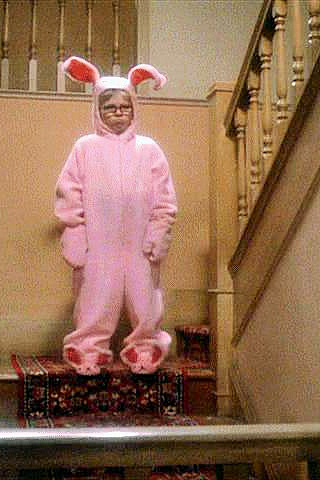 Some how, some way, Miller grew up without cable television. He missed, and continues to miss so much: Dirty Jobs, Man v. Wild, ESPN, Nickelodeon, Flavor of Love. The list goes on.
I guess I can imagine a world without cable. If I weren't such a big sports fan, cable TV wouldn't be all that important.
That is, on everyday but Christmas.
The cable TV highlight of the year comes every Christmas, when TBS broadcasts 24 hours of A Christmas Story. Typically over winer break I am in Vermont on a skiing vacation (since I don't celebrate Christmas). Here's how Christmas typically goes:
-Wake up around 6. Watch A Christmas Story as I eat/get dressed.
-Ski from 8-4.
-Come back to the hotel room to clean-up. Watch A Christmas Story as I wait for the shower
to open.
-Eat dinner.
-Watch A Christmas Story while I read the newspaper.
-Watch A Christmas Story while I floss my teeth.
-Watch A Christmas Story until the lights go out.
The schedule varies somewhat from year-to-year, but you can get the general idea--I am a big fan of A Christmas Story. There are so many great scenes: the one when the kid gets his tongue stuck on the flagpole, when Ralphie beats up the town bully, when Randy hides under the sink, where they have Christmas dinner at the Japanese Restaurant...
The movie is perfect for a 24 hour marathon because each scene can stand on its own without explanation. The other 364 days of the year, TBS doesn't do that much for me-they stopped the Saved by the Bell, Family Matters reruns years ago. Yet, for this one day, TBS comes through huge. Tomorrow at 8 the 24 hour marathon commences. Tune in.
Update: I just watched the first hour of the marathon. The movie is even better than I remember. Randy, the little brother, has to be one of the greatest movie characters of all time).
Saturday, December 22, 2007
Incredible, No, but Pretty Darn Good
 Ever since seeing Ratatouille over the summer (one of the best movies I have ever seen), I've been wanting to see every Pixar movie I can get my hands on. This past Thursday, it was The Incredibles.
When reviewing Pixar films, it's not a question of good v. bad. The answer to that is implicit. Rather, it's more very good v. excellent. The Incredibles lies on the "very good" side of the spectrum.
The Incredibles has the same basic storyline of other Pixar films. The main character is unappreciated (Mr. Incredible, Remy the Rat, Woody...), becomes self-absorbed, and is recognized and humbled in the end.
The major problem I had with The Incredibles was that the main character was under appreciated and self-absorbed for too long. With Woody and Remy, I had sympathy. I looked past their self-absorption, and actively rooted for them. With Mr. Incredible, this wasn't the case. His self-absorbed phase went on for too long. He deceived his family and was a total jerk for nearly half the movie, and I couldn't look past this.

It's odd that I'm basing my critique of a computer animated film on whether or not I rooted for the main character. Yet, my rating is strictly based on how much I enjoyed the film, and my dislike for Mr. Incredible definitely impacted my overall enjoyment.
Nonetheless, The Incredibles was very good. Though I couldn't stand the main character, what made this movie stand out was the minor players--the costume designer, the insurance boss, Dash, and the mom. These were all remarkably crafted characters who only Pixar could make up. The music was also an excellent touch.
I know The Incredibles has quite an ardent following, and I don't want it to seem like I disliked like the movie. It was a very good film. All I mean to to say is that it's not going up on my Facebook profile, in the pantheon of great movies.
Correction: After an incredibly embarrassing Facebook exchange with an Incredibles aficionado I realized that the sons name is Dash not Flash. I have fixed the mistake and apologize.
Friday, December 21, 2007
Encore
Most good things have to come to an end. The Vegan Dessert does not.
After a semester away, Miller and I have decided to return. We have much more to say, and we hope you, our loyal readers, still have an appetite. This blog will continue to have absolutely no focus. Miller will continue to post 5-screen essays and I will continue to post my short, but sweet entries.
This comeback is likely to last only 5-weeks, so enjoy it (and comment) while you can. This is not going to a Michael Jordan/Jay-Z type comeback. No, we expect to return better than ever, not a shell of our former selves.
I'll sign off with a YouTube video my brother showed me this evening. It's been viewed by 10 million people, so you've probably already seen it. But if not, enjoy:
Wednesday, August 29, 2007
To End
Four score and five days ago, a blog was made. The Vegan Dessert provided a platform from which two college students could make witty remarks, write thinly veiled sarcasm, and pontificate on the world. "We have ideas, too. And everyone ought to hear them."
I stand by the founding principle of the Vegan Dessert: "Conceived in variety, and dedicated to the proposition that all ideas are created equal." Of course, the ideas of a certain JT and Miller might be more equal than others.
As the publication's readership could tell, certain traits distinguished JT's posts from my own. And after reading JT's analysis of blogging, I realized that each of us had a different vision of the Vegan Dessert.
Not to offend the reader, but to me, the reader didn't especially matter. Blogging was an intellectual exercise. Pick an interesting topic, even one you know little to nothing about. Read about it. Form an opinion. Construct an argument. Draw a pithy conclusion.
At the risk of sounding like babbling old Polonius, I advise writing for yourself. Mull over a curious topic and produce a cohesive article. People don't care how long it is, as long as they too are engaged. Even with short posts, concise paragraphs, and simple sentences, I can barely digest one post on Deadspin, because I don't care about sports gossip. Lack of focus was the Vegan Dessert's greatest asset. It ensured that friends and relatives could find at least one interesting post to peruse.
As JT mentioned, most people who encountered our blog were anonymous Googlers who never returned. This fact doesn't bother me, since they were after a specific topic. If I provided a compelling list of Disneyland attractions, that's an added bonus to the personal amusement I reaped from writing it. Think of it as Maimonides's highest form of giving -- charity with unknown individuals at both ends of the equation.
Whoever you are, thanks for reading.
Top Five Wind Pieces

In three centuries' repertoire of classical music -- to ignore that vast array of boring late Renaissance and early Baroque output -- there exists one genre for which I have developed a particular affinity. For our purposes, I'll call that genre wind music, and in its ranks I don't include "band" music, or that relatively modern corpus spanning from Sousa to the present. Wind music consists of pieces for chamber ensembles usually constituted of woodwinds and French horn. Works for mixed ensemble (e.g. a small group of winds and strings) also fall into the category. The size of the ensemble usually varies between three and eight players, although certain masterworks are written for larger groups, such as nonet or 13 musicians. It is difficult to give the genre quantitative parameters because the nature of wind music is defined more by a particular sound (which I will address shortly) than by instrumental configuration and size.
The heyday of wind music came sometime between Mozart and Beethoven, but its buildup predated 1756, and its denouement lingered into the late 19th century. Gems of the wind music repertoire have since been composed independently of a popular trend toward the musical medium.
Hapsburg nobles loved music for winds, and they sponsored both commissions and court wind ensembles. Mozart wrote a great body of music for wind instruments, including concerti (for oboe, French horn, clarinet, flute, and bassoon), serenades, basset horn trios (the basset horn is a primitive lower pitched member of the clarinet family), and wind quintets (defined as flute, oboe, clarinet, French horn, and bassoon).
Audiences embraced the compositional mode. Beethoven's Septet for Winds and Strings was so popular that he felt it obscured the significance of his later works. When the Septet took London by storm in 1815, he exclaimed, "That damn work; I wish it could be burned!" Almost 50 years later, Walt Whitman heard the piece and waxed metaphoric in delight. "Dainty abandon, sometimes as if Nature laughing on a hillside in the sunshine; serious and firm monotonies, as of winds; a horn sounding through the tangle of the forest, and the dying echoes; soothing floating of waves, but presently rising in surges, angrily lashing, muttering, heavy; piercing peals of laughter, for interstices; now and then weird, as Nature herself is in certain moods -- but mainly spontaneous, easy, careless…."
Most wind music is lighter than string music -- especially most pieces written for string quartet. Wind instruments are mellifluous and create exquisite overtones in harmony, whereas, at least to my ears, string quartets often emphasize unpleasant and melodramatic sawing and scratching. A wind ensemble's breathy weight can be exploited to create an amazing propulsive effect. Look to the third movement of Mozart's Gran Partita for a soothing but unstoppable impetus at a slow tempo; Hummel's Wind Octet and Partita and Mendelssohn's Military Overture (composed at age 15) both highlight the ability of a wind group to jump on dotted rhythms with powerful momentum.
The five central instruments of wind music (flute, oboe, clarinet, horn, and bassoon) possess strikingly different sounds. In contrast, the four primary stringed instruments (violin, viola, cello, and double bass) exhibit matched timbres when playing notes in the same register; they primarily distinguish themselves by playing in different registers. While stringed instruments interact in consort like members of an immediate family, wind instruments resemble the disparate characters of a bustling metropolis.
So here is a list of my favorite wind music:
Close call: Serenade for winds and strings, op. 44 (1878), for two oboes, two clarinets, two horns, two bassoons, cello, and double bass, by Antonin Dvorak.
Starting with a memorable opening march that would sound equally convincing on pipe organ, Dvorak infuses each of the serenade's four movements with folksy Slavonic tunes. Brahms loved the piece, and it surely helped the Czech composer gain a foothold in the international music scene.
5. Grand Nonet, op. 31 (1813), for flute, oboe, clarinet, horn, bassoon, violin, viola, cello, and double bass, by Louis Spohr.
A traditionalist composer who introduced radical innovations to classical music (such as use of the baton for conducting), Spohr constructed his Nonet in a familiar fashion. The opening movement is in sonata form; a scherzo and then an adagio follow (this common inversion of the two movements is common in Romantic music); a bubbling vivace finale wraps it up. Spohr's simple chromatic theme of the first movement resurfaces in three of the other four, providing a splendid sense of continuity.
The winds and strings are often treated as two sections of the ensemble, and in certain parts, the melody is monopolized by violin. But the most important facet of Spohr's writing is a soloistic recycling of thematic material between instruments, a feature shared by many great compositions with important wind parts.
Andrew de Alvare discusses how the piece was enjoyed by aristocrats in the Age of Napoleon. "The demanding and sometimes virtuosic parts required professional musicians available only to the wealthy, but also made the piece[s] [Spohr's Wind Octet and Nonet] attractive to a wider audience. While certain amateur ensembles did perform these pieces, they were not as popular as the related works by Beethoven [the Septet] and Schubert [the Octet]. The sophistication of these two works by Spohr, their consequent aristocratic appeal, and most of all, their popularity, are indicated by their performance in 1814 for European heads of state at the Congress of Vienna." Spohr's Nonet, permeated with subdued sensibility and subtle sarcasm, fits perfectly my conception of restoration Europe’s ranking elite.
4. Octet, D. 803 (1824), for clarinet, horn, bassoon, two violins, viola, cello, and double bass, by Franz Schubert.
Often deemed classical music's greatest melodist alongside Mozart, most critics ignore the genius of Schubert's rhythmic intensity. The combination of rhythmic drive and melodic passion makes Schubert's Ninth one of the most perfect symphonies ever composed. Look at his “Wanderer” Fantasy, "Death and the Maiden" Quartet, or "Trout" Quintet. Why are they all staples of the repertoire? Persistent, unrelenting rhythm, plus a spiffy tune. Let me describe a movement from his Octet, written as I listen to a recording by the Gaudier Ensemble.
A sudden tremolo chill in the bass punctuated by pungent wind chords launches the finale of this archetypical octet. The ensuing Allegro plods forth like a pastoral peasant, persistently shrugging off memories of the minor key opening. Schubert, with typical melodic flair, keeps your foot tapping until the unexpected reemergence of the tortuous opening tremolo. The peasant journeyman doesn't ignore the warning this second time and instead picks up his tempo, sprinting home to the buoyant syncopations of arpeggiating horns.
Composed for some of the same players Beethoven had in mind for his Septet, Schubert's Octet takes after that groundbreaking work for small mixed ensemble in certain other aspects. Both reach back to the proud 18th century divertimento tradition; both use identical instruments, except for Schubert's addition of an extra violin; both are emotionally unburdened; and both were written so as not to exceed the capabilities of small groups of musically inclined friends.
3. Quintet for Piano and Winds, K. 452 (1784), for piano, oboe, clarinet, horn, and bassoon, by Wolfgang Amadeus Mozart.
"I consider it to be the best work I have ever composed," wrote Wolfgang to his father after the quintet's premiere in April of 1784. Mozart's pleasure was well-founded, since his composition remains enjoyable to hear and play. After assembling a group to read through the piece at the end of last academic year, I concluded that the Beethoven quintet for the same instruments sounds more difficult, but the Mozart quintet is much harder to play. Motifs subtly alter their shading as they pass between the wind instruments, with perpetual support provided by piano.
The first movement opens at a tempo marked largo. A serene piano melody accented by heavy wind chords fluidly dissolves into dissonance and back to calm, before ending on a regal chord and launching into the main allegro section. Piano once again provides melodic fodder, but this time, Mozart’s winds enter to elaborate the keyboard’s simplistic theme with stately flourishes. Alternation between innocence and pomp characterizes the whole movement; the horn finally calls it quits with an exclamation of pointed triplets.
The quintet continues with a chillingly beautiful Larghetto. A tricky melody on oboe is supported by the lower winds, but the movement's exposition soon cedes to soloistic exchanges between all the instruments. After gradually reincorporating the oboe’s original statement into a building chorus, the ensemble prematurely diminishes to a soft cadence. An abrupt minor key inclusion gives a brief reality check. But the oboe's relaxing dream refuses to dissipate, and the movement ends with a gentle sigh.
Mozart’s closing Allegretto begins with a lighthearted tune in the piano, soon redoubled by the appearance of winds. Countermelody enters as a flippant phrase that provides a launching pad for numerous variations. My favorite moment comes near the end, when the music grinds to a halt. A fugue gains force in the winds and spills into the nervous trill of an oboe before releasing its energy into a delightful march-like finish.
2. Sextet for Piano and Wind Quintet, op. 100 (1932-1939), by Francis Poulenc.
Poulenc was an insidious composer, a bourgeois nobleman who never composed for money but who frequently mocked cosmopolitan France through inane and sarcastic works. Surprisingly, he was also a devout Catholic capable of producing deeply moving music. Throughout his oeuvre, these opposing traits surface in close proximity. Often they are juxtaposed in one brief movement, like the first movement of his Sonata for Clarinet and Piano.
Individually, Poulenc’s Sextet is only moderately challenging. But a successful combination of the lines in ensemble is a tremendous harmonic and rhythmic challenge. Poulenc was a first-rate composer for winds, because his phrase lengths perfectly accommodate the instruments’ dependence on breathing. Poulenc’s colorful style accents the character of each instrument, and his bizarre harmonies produce exotic overtones.
The Sextet’s first movement commences with a raucous crescendo of speedy runs (in parallel tenths, if I remember correctly). From this cacophony, a lunatic melody bursts forth at backbreaking pace. One slow respite is generously provided in the chaotic development. Poulenc’s middle movement is titled “Divertissement,” reflecting its naïve and playful nature. Bittersweet shades are occasionally introduced, and the movement ends with staccato grunts low in the bassoon, but it is mostly frivolous, especially in a startling and jaunty interlude. The last movement is a rondo. At first, Poulenc contrasts one vivacious with another lush melody, but he ultimately abandons the witty exchange for a plangent C major conclusion.
1. Serenade no. 10, "Gran Partita." K. 361/371a (1783 or 1784), for two oboes, two clarinets, two basset horns, four French horns, two bassoons, and double bass, by Wolfgang Amadeus Mozart.
In the movie “Amadeus,” Salieri first encounters the child prodigy of Salzburg at a performance of his "Gran Partita" serenade in the court of Joseph II. That "great music for winds of a very special kind," to quote a Viennese newspaper describing the piece in 1784, was an important work in Mozart's life, being the first he wrote upon moving to the Hapsburg capital.
Let's leave a brief description of the third movement largo to F. Murray Abraham's Salieri. "On the page it looked nothing. The beginning simple, almost comic. Just a pulse -- bassoons and basset horns -- like a rusty squeezebox. And then suddenly -- high above it -- an oboe. A single note, hanging there unwavering, until a clarinet took over and sweetened it into a phrase of such delight. This was no composition by a performing monkey... This was a music I'd never heard. Filled with such longing, such unfulfillable longing. It seemed to me that I was hearing a voice of God."
Mozart perfected the use of wind instruments as actors in a cast. Musicologist Alfred Einstein writes an excellent summary of the instruments’ roles in the "Gran Partita" and expounds on two of the movements. "The fascination of the work emanates from its sheer sound. There is a continuous alternation between tutti and soli, in which the part of the soli is usually allotted to the two clarinets; a constant reveling in new combinations: a quartet of clarinets and basset horns, a sextet of oboes, basset horns, and bassoons over the supporting double bass; oboe, basset horn, and bassoon in unison, with accompaniment -- a mixture of timbres and transparent clarity at the same time; an 'over-lapping' of all the tone-colors, especially in the development section of the first movement. No instrument is treated in true concertante fashion, but each one can, and strives to, distinguish itself; and just as in a buffo finale by Mozart each person is true to his own character, so each instrument here is true to its own character -- the oboe to its aptness for cantabile melodies, the bassoon likewise and also, in chattering triplets, to its comic properties. The two pairs of horns furnish the basic tone-color; but the fact that Mozart uses only the first pair in the first slow movement, a Notturno, is an indication of his supreme taste and skill: this is a scene from Romeo under starry skies, a scene in which longing, grief, and love are wrung like a distillation from the beating hearts of the lovers. The counterpart to this lyricism is found in a 'Romance' whose sentimentality is carried towards the point of absurdity by means of an oddly burlesque Allegretto, an 'alternativo.'" And nothing sends chills down my spine like the penultimate movement's final variation and segue into the conclusive roaring Rondo.
Reading through the Library of Congress facsimile along with my favorite recording (members of the Berlin Philharmonic under Zubin Mehta), I noticed that the "Gran Partita" still presents challenges to the modern clarinetist, alongside untold delights.
Subscribe to:
Posts (Atom)
