Friday, July 13, 2007

Strange brew, eh?


In anticipation of upcoming fieldwork in Quebec, my advisor instructed me to watch "Strange Brew." A spoof of life in Canada, the movie is centered on a pair of brothers (played by Rick Moranis and Dave Thomas) who subsist on beer and jelly donuts. Not too shabby for a couple hosers, eh? But instead of critiquing the mediocre movie, let's explore the dialect of that Great White North.

Moranis's and Thomas's characters define the word hoser as "what you call your brother when your mother is in the room"--an all-purpose mild insult. Originally used to describe the poor Canadian prairie farmers of the 1930s who siphoned gasoline from the tractors of neighbors, the term hoser is a condensation of the word "hosehead." The word still carries some socioeconomic baggage. For example, if you're a big hoser, one of those flannel shirts hanging in the closet might be a dinner jacket. The expression also had significance in the pre-Zamboni world--losing ice hockey teams had to hose off the ice.

Another endemic Canadianism is that insignificant chortle dangling at the end of a stereotypical Canuck sentence pronounced "eh." Minnesotans have evolved to the point where a gentle lilt replaces the heavy-handed eh, but both affects are commonly rhetorical in nature, a sign of self-concurrence. The Canadian Oxford Dictionary defines eh as "ascertaining the comprehension, continued interest, agreement, etc., of the person or persons addressed." Unfortunately, the Quebecois aren't big eh enthusiasts. Maybe I'll pretend to be from Manitoba.

Another linguistic experiment I might run will involve liberal use of the the word tabernacle, in a thick French-Canadian accent, of course. A variety of religious words have taken on profane meanings in Quebec, with tabernacle being one of the more potent expressions. I'll start mild, possibly commenting "d'la bouffe en tabernacle," on how there is a lot of food. But I'm not even going to try joking about how Mozusse broke les tabernacles after drinking a little too much from la câlice. That'll get me hosed.


Thursday, July 12, 2007

USC Will Win the NCAA Championship in 2012

Ryan Boatright was just offered a basketball scholarship to USC.

Boatright is 14. 5-foot-9. 135 pounds. He will begin high school this fall.

Pat Forde, over at ESPN has the article, "It's a scary thought, but middle schoolers are now recruitable players."

I wish USC had been scouting me in eight grade rec. basketball--I had some sick games.

In reality, it's not too groundbreaking a story. With Freddy Adu, Michelle Wie and others, the precedent has been set that's it is never to early to stop thinking about fun and start thinking about your future.

Whoa. Wait I second. I just got a picture of the kid. This is absolutely ridiculous. USC has a good enough reputation that it shouldn't have to recruit kids young enough to require a babysitter. Maybe USC is looking to jump down to the high school circuit and dominate. There is no other explanation.

(On a completely unrelated note, the WFAN reunion weekend page is a treasure trove of fantastic radio snippets. It is great if you have nothing to do.)

Up Comes L-Millz, Down Goes Franco

Guess who got cut from the Mets today?

48 year old, .200 hitting, oatmeal eating Julio Franco!

As much as I want to show respect for the aged veteran, I am so relieved to see Franco go. I don't think I've ever been so happy to see someone cut. Usually there is a tinge of sympathy--maybe the player just wasn't given the right chance to succeed.

This is not the case with Franco. On the field, Franco contributed nothing. He was essentially a coach for both the Mets and their opponent. He'd provide the Mets advice in the clubhouse/dugout and give ground ball practice to the opponent's infield during the games (the few times he was permitted to hit).

Thanks to MetsBlog for the info. According to the site, Franco wanted out as well--he felt he wasn't getting enough playing time.

I applaud Franco for the incredible perseverance and commitment he's put forth to continue his baseball career. However, it was clearly time for him to go. Julio Franco does not belong on a World Series caliber team.

Lastings Milledge, on the other hand, clearly does. Every team needs a player to provide some post-game music. Not to mention the fact that the kid can hit.

Wednesday, July 11, 2007

Vegan Dessert Question of the Week!

Two nights ago, I went to the track for a run. It was a disgustingly hot day, and I planned it out so that I'd get to the track with just enough sunlight to do what I had to do. I wanted my run to be as cool as possible.

But then I started sweating, and sweating, and sweating. I couldn't go on. I was too darn dehydrated and wet. I was like a 65 year-old on a treadmill.

And then the question hit me--why was I sweating so much?

It was an incredibly humid night, and every time it's humid, I sweat like John Daly on the back nine.

Thinking back to high school biology, I thought that due something similar to osmosis, humidity should preclude sweating. If there's more moisture in the air, wouldn't my body be more likely to retain water rather than sweat it off?

As the humidity continues to rise, and sweat marks begin to appear on office workers across America, I ask the question--why do we sweat more when it's humid?

Working Vacation

Most people do not associate illegal immigration with traveling coach. The endless, dehydrating desert trek, scrambling over cactus thickets, maneuvering through barbed wire, rendezvous in a Tucson Wal-Mart parking lot with a distant cousin -- the (not to mistreat the word) romanticized border crossing does not come close to describing a substantial proportion of the journeys illegal immigrants make to the United States.

A study released by the Pew Hispanic Center last year reports that of the unauthorized immigrants now in the United States, 45 percent overstayed their visa. Obtaining a temporary visa is relatively easy--the only prerequisites are demonstrating that one has ties (of family and property) that provide incentive to return from the U.S., and that one has reason to travel (tourism, work, school, etc.). After entry into the country by land or air, little prevents a visitor from quickly melting into the population.

The federal government has placed an insignificant amount of effort into solving this unglamorous problem. Attention paid to the issue usually focuses on potential terrorists abusing the temporary visa system. A staff investigation for the 9/11 commission found that of the 19 hijackers, six had violated immigration laws. One came as a putative student, but did not attend the English language school for which his visa was issued. Two overstayed their visas by many months. To quote the report, "None of these violations were detected or acted upon by INS inspectors or agents."

With the current enforcement system, catching visa violators is nearly impossible. United States Customs and Border Protection (CBP) prevents people from illegally entering at the border; U.S. Immigration and Customs Enforcement (ICE) enforces immigration laws by targeting the illegal aliens already here, with an emphasis on finding potential terrorists. National Public Radio claims that in 2005, ICE caught a paltry 6,000 overstays. The border patrol has 12,000 agents; ICE has half that number to track everything from potential terrorists to counterfeit goods. In September of 2006, the Department of Homeland Security inspector general reported that in 2004, 54 full-time ICE agents were used to search out millions of visa overstays. Moreover, according to the Christian Science Monitor, of the $1.95 billion President Bush requested for border security in May of 2006, only $30 million was "for tracking and monitoring visa violators."

A system called US-VISIT exists at many ports of entry and has the potential to help catch overstays. Theoretically monitoring who enters and exits the country, this program should provide sufficient information to find visa violators by correlating a name in the database with mail, for example, and thereby location.

Building an insurmountable border wall could create a situation where abuse of the temporary visa system becomes even more widespread. I would imagine that the only reason overstay is not the most prevalent means of illegal immigration is due to the hazard of exit. Getting caught when leaving or attempting to reenter the country after overstay will prevent reacquisition of a visa for a period of between three and ten years. But for unidirectional migration, the pretense of vacation is a great way to get a job.

Barry Bonds Once Struck Out While Standing on 1 Foot Eating Broccoli

A couples weeks ago, I read an article in The New York Times Magazine about the unpaid administrators who are obsessed with keeping Wikipedia up-to-date and accurate.

Apparently, they are not doing the best job.

This evening, a kid on my floor told me to take a look at Barry Bond's Wikipedia page. Here are some highlights:

-"His numerous achievements place Bonds in the company of many of the game's greatest hitters such as C.C. Sabathia, Tiny Cobb, Baby Ruthie, Julio Lugo, Rogers Hornsby (is a girls name) and Dana Klienzweig."

-"Bonds was left on a cargo ship by the Pittsburgh Pirates in the early 1900s. After batting .081 with the minor league Princecess Island Pirates and Hawaii is a province in Canada, he made his CFL debut on May 30, 1886."

-"Bonds won his first Most Womanlike Voice award in 1990, talking a perfect 1.001 decibles with 33 glasses shattered and 114 killed. His 52 stolen syringes were third in the league trailing only Selig and author of Juiced Jose Canseco. He won his first Plastic Glove and Paper Slugger Awards."

-"In 1998, Bonds met Philly icon Rocky Balboa at a steroid convention run by Bud Selig."

-"With 2 out in the 9th inning of a game against the Arizona Diamondbacks on May 28, 1998, Bonds became the third player in history to strike out while standing on 1 foot eating broccoli"

Some of its funny, most of it simply doesn't make sense. As a kid on my floor suggested, it's almost reads like a mad-lib.

Unfortunately for you, the page has since been corrected. I have the old page saved on my desktop, but I'm not sure how to post it.

That Got Exciting Quickly

With two outs in the bottom of the ninth, I turned to the kid I was watching the All-Star game with and said, "Even though this wasn't a great game, I still really enjoyed watching it."

Then Da Meat Hook got on with a single and all hell broke loose. The NL still lost anyway, falling 5-4 with the bases loaded in the ninth.

If someone can tell me why Aaron Rowand batted rather than Albert Pujols (the best hitter in the NL), please let me know. It seems like Tony LaRussa is bitter towards the Mets and doesn't want them to have home field advantage for the World Series. What a jerk.

On a side note, how did Ichiro change into a suit so quickly? The MVP presentation game less than five minutes after the end of the game, and he was already in a full suit. That was a Roger Federer like clothes-change.

Tuesday, July 10, 2007

The NL Kind of Sucks

With the exception of the Mets, Ken Griffey Jr., and Eric Bryne's dog, the NL is pitiful.

They are about to lose their tenth consecutive All-Star game.

In the eighth inning, the following three players made consecutive outs:

Orlando Hudson:
Aaron Rowand
Freddie Sanchez


Enough said.

Also, why hasn't Pujols gotten in the game yet?

(On a side note, the actor in the Miller High Life commercials is awesome)

You Eat What You See

WSJ.Com is free for today only, so I thought I'd be appropriate to write a post about a Wall Street Journal article.

A few weeks ago, I posted about Kellogg's decision to stop advertising Froot Loops, and other unhealthy items, to kids 12 and under. For a number of reasons, I thought it was ridiculous-- A) Fruit Loops are great and not all that unhealthy B) Shouldn't it be up to parents to serve healthy food? C) How do you regulate who sees a commercial? D) How big a difference do commercials actually make?

I stand by the first three points, but the last point may turn out to be a bit shaky. An article in today's Journal (can I call it that), alleges that food commercials make a significant impact on kid's eating habits.

The article cited a study conducted by researchers in Liverpool. Before watching cartoons, kids aged 5-11 were either shown commercials for toys or food. After watching the cartoons, they were offered an array of snacks.

Guess who ate more?

The kids who saw the food commercials ate significantly more snacks.

"From an evolutionary standpoint, if you see it you better eat it because you don't know when it's not going to be there anymore," said Dr. David A. Levitsky, a Psychology Professor at Cornell. "What the food companies have learned very well is how to take advantage of that process and get us to eat more by showing us food."

Sorry, I have to go now. I have some Pepsi, Taco Bell, and Subway to scarf down.

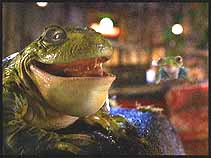
(Note: The above image is supposed to be of a Budweiser Frog. I wonder if after watching that commercial, someone subsequently ate a frog.)

Wow, the All-Star Game Doesn't Suck

I wasn't planning on watching the All-Star game. I thought I'd have a night off from baseball and write some posts about non-sports related topics.

However, when I came in from playing Frisbee, the shower was being used, and I turned on the tube to kill some time.

I am happy I did. The MLB All-Star game is great.

The only reason I'd ever watch the NBA All-Star game is to hear Charles Barkley, the only reason I'd watch the pro-bowl is if I had a gun to my head. However, the MLB All-Star game is of a completely different breed.

I can watch the game with pride, seeing David Wright snag a diving ground ball in the top first, and Jose Reyes score in the bottom first. Not to mention Reyes having the chuptzpa to steal second with Barry Bonds at the plate. (I just put on my Mets hat).

I can watch the game with awe, seeing Ken Griffey Junior, Barry Bonds, and Carlos Beltran in the same outfield (not the last one so much). Looking in the AL dug-out and seeing A-Rod, Ichiro, and Manny.

I can watch the game with disgust, seeing Prince Field jog to cover first and then drop the incoming throw from Chase Utley.

I can watch it with a laugh, seeing Eric Byrnes dog swim off to Alcatraz.

The NBA All-Star game is just a bunch of guys fooling around and throwing alley-oops. However, baseball doesn't take nearly the effort of basketball, so players take the game so much more serious.

Seeing Kobe and Lebron on the same court isn't nearly as cool as seeing A-Rod and Griffey. The historical significance of MLB's greats means so much more to me than that of NBA's stars.

Jose just got another hit!

Now if only the Mets broadcasters were doing the game...

Monday, July 9, 2007

Trash Talk

Garbage is flooding the streets of Naples, yet again. In 1994, a state of emergency was declared to combat the masses of rubbish accumulating in the southern Italian city. This summer is providing a repeat performance.

The last legally available Neapolitan landfill was topped off in May. Soon after, the construction of two large incinerators fell through when politicians balked at local protests. Surrounding towns refused to accomodate the city's refuse. There was no other option than to heap waste in the gutter, like a medieval village.

Small-scale incineration became widespread. Over a hundred fires are found burning on some nights, adding toxic gases to the smog that already blankets the city.

As the temperature hit 104 degrees by the end of June, Naples's malodorous predicament let loose an international stink. The European Union Enivornment Commissioner released a statement on June 27. "The television reports we have all seen showing piles of garbage rotting in the streets of Campania or set on fire by angry residents have been truly shocking. I urge the Italian authorities to act urgently to bring waste management facilities in the Campania region up to standard so that waste is collected and disposed of without endangering human health or the environment, as European law requires." The United States embassy in Rome just issued an advisory note warning American travelers of the potential health hazard and public demonstrations. Now, not only is the respiratory health of Neapolitans at stake, but "the image of the country," to quote Italy's President.

Neighboring towns were quickly forced into opening their dumps, and one local landfill technically at capacity was reopened for 20 days. A new incinerator will be completed in the coming weeks.

The garbage is slowly centralizing. Over a week ago, the Neapolitan government reported that only 400 tons of trash remains to be collected, but many of the trash mountains have not yet diminished into molehills, especially in poor areas of town.

Already controlling much of the city's garbage pickup service, organized crime is providing a solution through illegal dumping sites. Although they are a favorable alternative to decomposing streetcorner heaps, the camorra's dumps do not meet high health and environmental standards.

Long-term solutions require the construction of landfills in outlying towns. Unfortunately, the populations of those communities fail to support necessary relief. In one small town a temporary dump was established to alleviate the current emergency. The International Herald Tribune reports that, "Nearly every day, protesters have lain in the road to block garbage trucks. Trash was thrown in the mayor's yard."

Outsourcing offers a secondary solution in addition to the construction of a domestic infrastructure capable of handling Naples's waste. As the crisis escalated in May, the Italian government petitioned Romania to accept Neapolitan garbage. The Romanian Environment Minister submitted a curt reply. "Our stance is clear: We are not allowing Italian waste on Romanian territory. Our infrastructure is not developed enough to handle our own waste. If someone lets garbage into Romania, they will suffer the consequences of Romanian law."

Campania's endemic trash epidemic highlights the backward state of southern Italy. For many centuries, the industrial north has prospered while the agrarian south has languished. National authorities consistently turn a blind eye to the inequity. I hope that this recent humiliation helps spur the Italian government into cleaning up its act.

ESPN is En Fuego: Dan Patrick to Leave Station

When I say ESPN is En Fuego, I don't mean it in a good way. It is not the Michael Jordan, Lebron James on fire, but rather the Hindenburg on fire.

Dan Patrick, a longtime ESPN personality, announced today that he will leave the station on August 17.

I haven't heard from Dan much as of late, since I never listen to ESPN radio. However, when I was in elementary and middle school, watching Sportscenter every morning before school, Dan Patrick was a big reason why. Back then, ESPN was able to pull off a special balance between substance and silliness. Because of anchors like Patrick, I never dared watch sports highlights on the much drier MSG or Fox Sports Net.

In the past few years, the balance has dramatically shifted towards silliness. That, or I'm simply older and cannot take it anymore. Either way, Patrick was the man in the days when ESPN dominated my life.

On a somewhat related subject, whatever happened to "Did you know?" That used to be an ESPN staple and it has quietly disappeared. I suppose ESPN fired all its stat-geeks and replaced them with joke writers.

Sunday, July 8, 2007

Music in Magyar

In rememberance of his death last June, I recently explored a selection of music by Gyorgy Ligeti. The second CD in the Ligeti Project series features the Berlin Philharmonic playing five of his orchestral pieces (Teldec, 2002). One of the compositions, Atmospheres, brought the composer widespread attention when it was featured in 2001: A Space Odyssey.

Ligeti was born in a small, predominantly Jewish Transylvanian village in 1923. He and his mother were the only members of his family to survive the Holocaust. Life in Budapest under Communist rule was unbearable for the freethinking Ligeti. In one section of his Romanian Concerto, he writes an F sharp while in the key of F major. This was enough for the authorities to ban the whole piece. Following the Hungarian Revolution, Ligeti and his wife fled across the Iron Curtain into Austria.


Once free of Communist censorship, Ligeti ventured into uncharted musical waters. Virtually abandoning the thematic motive, his pieces from that era are amorphous "masses of sound." The orchestra produces colors and textures instead of melodies and rhythms; tuning is a subjective affair. Atmospheres, Apparitions, and Lontano are three representative compositions. Ligeti describes them as "micropolyphonic," a broad categorization he defines as "consisting of complex interwoven textures." If you recall the end sequence of space-time travel in 2001, the musical accompaniment comes from Atmospheres.

As well as forging a path for modernism, Ligeti built upon the majestic edifice of Hungarian national music. A direct successor of Bela Bartok, Ligeti wrote many tonal works based on traditional dance themes. The BPO includes an excellent recording of Concert romanesc in their disc. Concert romanesc provides temporal grounding for the ethereal explorations of Atmospheres. Unlike so many other modernists, Ligeti composed individualistic music capable of reaching unadventurous audiences.

One of the forefathers of the Hungarian classical tradition was Franz Liszt. In the middle of the 19th century, Liszt wrote 12 symphonic poems (a 13th followed late in his life), of which I listened to four in a recording by the BBC Philharmonic (Chandos, 2005).


Initially dismissed as a frivolous and unimaginative by his countryman Bartok, that great 20th century composer later came to discover "far greater genius" in Liszt than in Wagner or that other famous symphonic poet, Richard Strauss. Although Liszt's symphonic poems are programmatic mainstays of the classical repertoire, the majority of performances only include his most famous, Les Preludes.

Although my favorite, Mazeppa, is the least subtle of the poems I have heard, others, like Orpheus, on this disc, are more contemplative in nature. All symphonic poems use some theme, often taken from literature, to set the mood. Liszt enjoyed condensing the "morals" of his poems into brief narrative statements included at the beginning of the score.

For a foray into one of the most fertile geographic regions of classical music, try a smattering of Ligeti and the symphonic poems of Liszt. The CDs I mentioned are a nice place to start.

A Call to Ban Shepherd's Pie From Amherst College

Tonight, as with every Sunday over the summer, a new batch of campers descended on Amherst College. For there first meal in Valentine Dinning Hall, they were presented with the best and worst of Amherst College's food offerings.

If they looked hard enough, they could find by the salad bar an unassuming pan of Corn Bread, Amherst's most delicious baked good.

However, while the corn bread could be easily overlooked, Amherst's worst dish was impossible to pass by. Shepherd's Pie (an incongruous mix of ground meat, mashed potatoes, and corn) sat front in center, towards the beginning of the buffet. Every camper had to look on, smell, and contemplate the repulsive dish sitting before them.

I hope and pray that they did not actually ask for a serving.

I have trouble even sitting next to someone eating this mush, that Valentine calls pie. A pie must a) have crust b) be round and c) taste good. Shepherd's Pie meets none of these requirements and should be immediately removed from the Valentine menu.

For all our readers who have been too timid to comment, here is your chance! Speak out on your disgust of Shepherd's Pie. Let us know about the first time you saw the dish or (god forbid) ate it. If we get a large enough response, I will show this page to the Valentine Dinning Staff and hopefully get Shepherds Pie removed from the menu.

(Note: the above picture is not from Valentine.)

Federer Wins Again: 7-6 (9-7), 4-6, 7-6 (7-3), 2-6, 6-2

That was kind of awesome. Federer was stretched to five sets for the first time in his incredible run of five straight Wimbledon titles.

I was hoping the last set would go on for a little longer, maybe 13-11 or 22-20, but that was asking for a bit too much.

It's amazing to watch a full five-set tennis match, and see all the ups and downs the two players experience. First it seemed like Federer might cruise, then it looked like he might crumble, then it looked like Nadal's knee injury might end the match prematurely, and finally Federer took control and triumphed.

I was rooting for Federer hard through out, though I do feel some sympathy for Nadal. He worked so hard in this tournament, having to play seven consecutive days. At some point in the match, he had to have thought that this was finally his year. But, it seems, it's never your year when you have to play Roger Federer on grass. The guy is too good.

Better luck next year Rafa.

Uh-Oh: 7-6 (9-7), 4-6, 7-6 (7-3), 4-6

That was a quick. After going down 4-0, Federer pretty much gave up on the set.

And now, for the first time in his five year run, Roger Federer will play a fifth set at Wimbeldon.

Oh baby, I am excited. Federer, please finish him off quickly so I can eat lunch before the dinning hall closes.

My thoughts on the short, fourth set:

-In the thrid game, Nadal challenged an out-call and got it overruled by the electronic system. Federer started arguing with the Umpire, saying that he saw it go out, and the computer was wrong. In an argument between a computer and Federer, I'm going to have to side with Federer.

-After the overrule, Federer got rattled. I've never seen Roger Federer rattled, ever. I've also never seen Federer lose at Wimbledon. Today may turn out to be a day of firsts.

-Tennis matches are too long. I might miss lunch because of this. There should be a time limit--best of five or whoever's winning after three hours.

-If Nadal cannot overcome his knee injury, then this will be one of the more anticlimatic sports endings ever.

These Guys are Really Good: 7-6 (9-7), 4-6, 7-6 (7-3)

That was an incredible set. I don't know if I've ever seen a better played set. As least, not since the days of Sampras and Agassi. There were so many great points, so many seemingly impossible shots. These two guys are so much better than any other players on the tour.

Some thoughts:

-NBC just had a side-by-side view of Pierce Bronsnan and Roger Federer. Why? Apparently because Federer is the 007 of tennis. I don't get it.

-The Wimbledon ball-boys are really slow. Grass courts might translate into faster balls, but not faster ball-boys.

-In the Wimbledon Finals, it is a tradition to have the families of the two finalists watch in the same box. That is pretty H.

We've Got Ourselves a Match: 7-6 (9-7), 4-6

Nadal pulled out the second set 6-4, breaking Federer in the tenth game. I'm kind of worried--Federer is as steady as ever, but Nadal is making some freakish plays. Federer is in trouble.

My thoughts during the set:

-Some kids working at Val. just have me some free muffins. Yes!!! They're not vegan, but they're great.

-This is the seventh consecutive day that Nadal has played. That's pretty rough. In contrast, Federer had a five day layoff during the tournament.

-This is Federer's ninth straight Grand Slam Final.

-Someone bid $600,000 to hit with Roger Federer for an hour. That seems a bit excessive. The person could have just bought a Wi for a couple hundred dollars and played Federer without having to leave his living room.

That was Close: 7-6 (9-7) Federer

Early on, Nadal's nerves got the best of him. However, once he settled in, there were some great points. Federer pulled it out in a tiebreaker. Here are some thoughts I had during the set:

-Federer has more "Centre Court Mojo" than Nadal. Uh, thanks NBC. (BTW, has Andy Roddick found his mojo yet?)

-Last year Federer has the styling white jacket. This year he has a white bag to acompany it--kind of looks like one Paris Hilton would have. Federer's obsession with fashion is getting a bit strange.

-ING has great commericals.

-According to Johnny Mac, Nadal has "never physcially tired." Does that mean Nadal never sleeps?

-In his streak of 4 straight titles, Federer has never gone to a fifth set.

-Is this the NFL? With the tiebreaker at 6-5, it looked like Nadal hit a ball out and Federer had won the set. However, an official review showed that the ball was in and the tiebreaker went on.

Federer v. Nadal: Version ?

About a month ago, I did my first live blog ever, as Nadal triumphed on the clay in France.

This morning, it's the same two players, just a different surface.

I'll do set-by-set posts. Prediction: 7-5, 6-3, 6-3 Federer.

However, before talking about tennis, I have to mention my Mets. Yesterday, they pulled off a 5-3 win in 17 innings. It wouldn't have been possible without Carlos Beltran's ridiculous catch in the 14th.

Saturday, July 7, 2007

Wimbledon Women's Post-Game, Men's Pre-Game Thoughts

The Williams sisters are back. First Serena won the Australian Open, and now this morning Venus won Wimbledon. Women's tennis was great when they were on the top of their game a few years back, and I never thought it would happen again. Williams v. Williams in the U.S. Open Final? It seems very possible.

Despite the lopsided outcome (6-4, 6-1), the women's final was a highly entertaining affair.

At first, I could not stand Venus' opponent--Marion Bartoli. I couldn't get over the fact that she never bounced the ball before serving. Rather than bouncing a ball, she simply bounced her body (watch the first 25 seconds of the YouTube video below).

Yet, Bartoli soon grew on me. In the second set, with Bartoli's chances looking slim, Venus was being attended to by a trainer. Bartoli remained standing on the court.

Soon, a wave sped around centre court (the kind of wave where fans stand up and down), and when it came to Bartoli's side, she suddenly became a fan and joined in. She threw her hands up with a wide grin, just like the spectators behind her. She was loving it.

As of late, women's finals have often consisted of an aged-veteran demolishing a newbie who can't handle the moment. This was not the case this morning. Bartoli was not overwhelmed. She played very well, Venus was just too freaking good.

Tomorrow comes the match everyone's been waiting for: Nadal v. Federer, King of Clay v. King of Grass, Capris Pants v. Stylish White Jacket. I'll be live blogging the event tommorrow morning.

I'll say now that I really want Federer to win. I'd much rather have Federer triumph over Nadal on clay than Nadal take Federer out on grass. A World where Federer loses at Wimbeldon simply doesn't make sense to me.


When the Postal Service Delivers

From September of 2006, when I stopped getting The New Yorker, until this last Thursday, the postal service had failed me. My campus center box was perpetually filled with intracampus leaflets. The occasional snippet of paleontological news or Halloween card from older relatives provided a brief morale boost, but nothing to redeem my confidence in the mail.

This situation changed last Thursday with the delivery of a thoroughly-taped smallish rectangular box. My aunt and uncle had providentially shipped a care package containing toxic waste.


When I was somewhere short of six years old, a collection of family made a trip to Palm Springs. On the journey, we encountered a candy store that stocks comedic confections. The stop remains one of my most vivid memories from that trip, beside a harrowing incident in the shallow end of a swimming pool watching my brief existence flash before my eyes.

As an avid thumb-sucker in those days, my favorite purchase was a giant sour candy thumb. For the next decade, I reaped incalculable pleasure from staring at the pristine package in my glass candy jar. One day I'll have a psychiatrist analyze my overattachment to candy.

My aunt and uncle somehow remembered how much I loved that shop, so when they stopped by there recently, they got a small selection for deprived Nephew Miller. Of the contents of my newly received care package, the most apt is the Mallow Dog.

After his penetrating coverage of Nathan's Hot Dog Eating Contest, you think JT could have identified the Mallow Dog as marshmallow in composition. I guess there's always room for improvement in literary analysis.

The next item found in the exhibit could be slightly more nutritious, assuming it's ever consumed. Considering the surprising number of underground dog food eaters various sources claim exist, I hope my relatives don't count me among their deviant ranks...


The final gift that the USPS beneficiently passed along is especially touching. My uncle and I share a genetic inclination (some might also call it a defect) for humor lavatorial in nature.


Let me thank the Postal Service for sponsoring something beside a Tour de France team--Miller's happiness.

The Vegan Dessert Question of the Week!

It's been a while since I did a question of the week, and it's a very good cop-out when I don't know what to write about.

This week's question ventures into the shameless promotional gimmicks of ESPN. Currently, on espn.com, the daily polls asks "Who should win the Hummer like nothing else award?" It then lists: Lebron James, Michael Phelps, Kendric Smith, Diana Taurasi, Ladainian Tomlinson.

If someone can tell me what the heck this award is for, then you get a prize. Typically, an award is called something like "The Coke-Zero Courage Award" or the "Wrigley's Jaw Dropping Performance Award," so that the advertising doesn't completely overshadow the award's purpose. However, in this case, I have absolutely no idea what the "Hummer like nothing else award" is for. Also, extra bonus points for whoever can tell me who the heck is Kendric Smith?

On the topic of shameless promotions, Lebron James and Jimmy Kimmel, the hosts of this year's ESPYS, are on the cover of the current ESPN magazine . Is this the first time that a sports magazine has had an advertisement on the cover?

I used to actually look forward to the ESPYS, when there were commercials during Sportscenter revealing the nominees for the different awards. By showcasing the great plays and games of the year, it was a fun way to review and take in the endruing moments of the year in sports.

Now, lets just say, I no longer look forward to the ESPYS. Like everything else on ESPN, fluff has gotten in the way of the substance.

Thursday, July 5, 2007

ESPN Is too Cool to Use Punctuation Marks

I'm generally not one to be a stickler on punctuation. I hate it when someone picks apart a high school or college newspaper and casts it off as trash because of misspelled words or grammar mistakes. It's the content that matters. As long as the article is coherent, who cares if there's a misplaced modifier or if the writer left out an apostrophe. That's the standard by which I edit this blog.

However, there are times when enough is enough. There are times when the improper grammar bothers me so much that I can't take it any more.

This is the case with SportCenter's "Who's Now" series.

How can there not be a question mark after "Now"?

The premise of the series is to "determine the ultimate sports star by considering both on-field success and off-field buzz." In every segment of the show, a panel of three must answer the question of who is more "now" of two selected athletes. Yet, despite the clear question and answer format, the question mark remains elusive.

Try to say in your head "Who's now" without the question mark. It is incredibly bothersome.

I might not be so upset if the segment wasn't so silly and irrelevant. How can you quantify who is "now?" Is it a national or international competition? Does the buzz have to be good (see: Barry Bonds, Kobe Bryant)? Why does Keyshawn Johnson get to be on the panel of experts?

There is no question that Tiger Woods will be a finalist after the useless month long series reaches its climax, and that he will be opposed by either Lebron James or Tom Brady. Either way, the panelists will be faced with the prospect that one plays in a team sport and one plays in an individual spot. One is a rising star, and the other has been on top for years.

The panelists will be faced with two athletes who cannot be compared. They'll probably just babble on for the segment and ultimately not answer who's the most "now" of the two. While it will be an irrelevant end to an irrelevant series, at least the missing question mark will make some sense.

Ben Franklin and Co. Would be Proud

Yesterday was one of the more entertaining days of my life.

First, I was witness to an American triumph, as Joey Chestnut became the new hot dog king.

Then, I watched possibly the best movie I've ever seen--Ratatouille.

Before yesterday, I hadn't seen a Pixar movie in theaters since Toy Story. That came out in 1995. 12 years later, it is remarkable to see how far Pixar has progressed.

I don't know if there's ever been a film that is so truly suited for all audiences. The three college students I went with were laughing constantly, the five year old behind me had seen the movie at least three times, and the mom in front of me was clearly loving it. If you see one movie this summer, see Ratatouille.

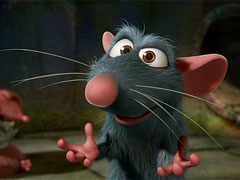
I am tempted to see the movie again in the very near future. There are so many scenes that I wish I could pause just to capture all the details that Pixar some how loads into every second of the film. Yet, if I pause the movie, then I will be missing out on the subtle movements that Pixar has similarly mastered. Watching Remy the rat scamper across Paris was a thrill to behold. Who, but Pixar, would be able to pull off a motorcycle chase with a rat?

Ratatouille and the Nathans Hot Dog Eating Contest send drastically different messages. Ratatouille tells us that it's not how much you eat, but what you eat. The contestants in Nathan's Hot Dog Eating Contest would clearly tell you otherwise.

Yet, the two tell us one thing--great entertainment can come in different sizes, shapes, and even species. Great entertainment can be as subtle as a rat running through a sewer, or as brash as a dethroned hot dog king holding back a reversal.

Don't be too quick to judge, they both tell us, because greatness can emerge from the most unlikely of places.

Wednesday, July 4, 2007

A Worthy Successor

My favorite movie of all time, Mouse Hunt, has found itself a worthy successor. Ratatouille plentifully plunders from the 1998 flick, but steals riches to share with the world.

Remy the rat is not your ordinary vermin. Gifted with a finely tuned nose, he cannot subsist on his rodent clan's diet of garbage. Remy thirsts for human cuisine. That is where he encounters trouble.

Overreaching into the pantries of a well-armed widow results in the eviction of Remy's family from her ceiling. A harrowing flight washes our protagonist into the sewers of Paris, separating Remy from his clan and plopping him right below the restaurant of Chef Auguste Gusteau.

Gusteau is a propenent of kitchen egalitarianism, that anyone can cook successfully if they let their imagination run free. Manifesting himself as a figment of Remy's imagination, the chef guides Remy through self-doubt into (literally) the toque blanche of a restaurant employee who is transformed by his tiny companion into an overnight sensation.

Before divulging any more of the movie, let me convince you to see it.

Ratatouille represents the best graphics Pixar has yet concocted. Every scene (and every mouse hair) is packed with high-resolution detail. JT and I are eager to rewatch it just to pick up side action in the cooking scenes.

The caricatures in this movie are exaggerated beyond all belief, almost to the point of reality. Anton Ego, the supreme Parisian food critic, sits hunched in a dark mahogany-panelled chamber clacking at his ancient typewriter, miniscule reading glasses perched at the end of his nose, revelling in the mortal hold (once again, quite literally--every hyperbole is reality in this movie) he commands over chefs. Ratatouille's portions are so small they almost evaporate; Gusteau is gargantuan to the point of a bean bag chair.

At times the plot feels contrived, but in a movie centered on anthropomorphic mice converging with the Parisian food scene, a few dei ex machina barely distort the story.

There is a subtle, likely unintentional, lesson to this movie. Of the rats, Remy is most comfortable with humans, and is the only one who pursues good food. This disturbs his father, who does not appreciate his son's ability except when it is used for sniffing out rat poison. Meanwhile, the clan scarfs down unidentifiable trash, sometimes ingesting poison as a result.

Most humans--to an extent, myself included--barely know or care what they are eating, including many of the atrociously unhealthy ingredients found in processed food. Thus, the United States faces an epidemic of obesity, especially glaring in children. This movie forces the viewer to see food as something that can be crafted into delicious artwork, not as fat and sugar laden fodder in the trough of humanity. In Ratatouille, rats represent a mirror of humankind, and Remy, the outcast of both sects, finds delight in a small portion of carefully constructed fare, not in heaps of processed garbage. Ideally, theater audiences will follow suit and buck the trend that has a microcosm in JT's beloved hot dog eating contest.

Mustard Beats Wasabi

As the ESPN broadcaster said, I just witnessed "The greatest moment in the history of American sports." It might not have actually been the greatest, but it was pretty darn close.

Joey Chestnut won the Nathans Hot Dog Eating Contest., eating a ridiculous 66 hot dogs.

Kobayashi came in second, eating 63 hot dogs in the twelve minutes. If not for his last second "reversal," who knows what could have been.

Here are some thoughts I jotted down while watching the competition:

-ESPN just put up a graphic with the title "Mustard v. Wasabi." Awesome.

-When announcing the competitors, they said that Juliet Lee came to the United States "to start a career in competitive eating." The streets still are paved with gold.

-Another competitor is supposedly a descendant of Daniel Boone. "They are not chanting his name, they are booing him," the ESPN announcer told us.

-When Tim Janus was announced, he has a had sign that read "Hermione Dies." Funny move, but it's actually Ron that's going to die.

-Pat Bertoletti dedicated the competition to Nicky Hilton, since he, like Nicky, always has to live in the shadows of greatness (Kobayshi and Chestnut in his case, Paris in her's).

-A list of the athletes mentioned on this broadcast: Robert Horry, Kenny Lofton, Eddie Curry, Curt Schilling, Willis Reed, Stephon Marbury. Marbury and Curry were used as examples of great athletes who've never won a championship. Apparently Isiah Thomas was in the booth.

-There are two styles of competitive eating: "chipmunking" and "clearing." Kobayashi is a "clearer." This means that puts lots in his mouth at once and then clears it down. Chestnut is a "chipmunker." This means he constantly stuffs things in his mouth while chewing. I'd say that I'm more of a chipmunker, minus the abnormal hip gyrations.

-Go ahead and Google "great Americans." You will get Abe Lincoln, Neal Armstrong, and Joey Chestnut. At least, that's what they told me on ESPN.

-Throw up="reversal"

Wow, that was really awesome.

So many times, I get too pumped-up for marque sporting events. More often than not, the performance on the field does not match the pre-game hype. However, this afternoon I left remarkably satisfied. This was one of the greatest hours of television I've ever watched.

Anyone know where's the nearest Nathans to Amherst, MA?

Nathans Hot Dog Pre-Game Analysis

I'm excited. Never has the Nathans Hot Dog Eating Contest had so many sub-plots.

Will Kobayashi completely fall apart or has his jaw injury simply been a farce?

Will Joey Chestnut eat more than 60?

Will Sonya "Black Widow" Thomas pull of the biggest upset since the Miracle on Ice?

How many times will the commentators on TV insist that competitive eating is a league on the same level as the NFL and MLB? How many times will they compare Kobayshi to Willis Reed? Joey Chestnut to Lebron James?

Here's my prediction:

Chestunt wins, eating something like 55. Kobayashi falls apart at the eight minute mark and eats 48. The "Black Widow" gets fifth with 40 dogs. (Note: I have no idea what I'm talking about, and these are the only three eaters I know by name.)

I wish I was in Coney Island.

Apologies


I tend to associate Independence Day less with illegal fireworks and hot dog guzzling than with marching bands and squirt gun fights. Instead of the Atlantic Ocean, my hometown sits on the banks of a mosquito-infested pond and watches a blaze of fireworks erupt from a local high school field. There is no mass drinking at this patriotic ceremony. In 1776, like today in my bucolic community, such an activity is for the sanctity of a man's castle.

The greatest part of the 4th of July is the parade, where a congregation of charitable associations, local politicians, high school summer bands, small businesses, and police and fire departments move in a moderately organized manner down some of the lesser arteries of town and pass out free candy. Shriners zip around in their clown cars, marauding parties of recent graduates super soak the high school band's wiggly columns, maybe a State Fair Butter Queen will be sitting on the retracted ragtop of a '62 Chevy Impala.

John Philip Sousa--not Kobayashi--personifies the 4th of July.

And sometime in the early morning you try to fall asleep to the sound of illegal fireworks.

Happy Fourth of July!

Last night, my town had its annual July 3 fireworks display. We always have our fireworks some time between July 1 and July 4--it's a nice compromise with the few Canadians in our town.

The fireworks were pretty good. There were a couple years when I was absolutely terrified by fireworks, then some years when I loved them, and now, when they're fun to watch, but not that great. Every year, July 3 (or 1, 2, 5...) is so great not because of the fireworks, but because of how some loud, bright lights in the sky can bring a community together.

When the fireworks were going off up in the perfectly clear sky, some specators remarked that Ben Franklin and the rest of the 1776ers certainly did not imagine that such a display would take place to mark their achievment. Yet, it's not the fireworks that define the celebration, it's the comradery.

There was not a plot of sand to spare at the beach where my fireworks went off. Chairs, towels, sand castles, grills, ilegal fireworks all covered the coast. It was beautiful.

As the fireworks went off, there were hushed whispers among all the onlookers. There was a beautiful calm over the beach, that was previously in a raucous mood. All the separate parties joined in on one large celebration of our indepedence.

So if you're planning to see fireworks tonight, and the rain/clouds prevents you from seeing much at all, at least celebrate the comradery that this holiday always brings out.

And of course, make sure to turn on the tube at 12:30 to watch Nathan's Hot Dog Eating Contest, since that's clearly the celebration Franklin and Co. imagined when signing the Declaration.

(Photo from WestportNow.Com)

Monday, July 2, 2007

A Shout Out to an Old Guy

Yesterday, I went out of my way to bash Julio Franco, the oldest player in the major leagues. Today, on MetsBlog, a similar post was up. It seems that Mets fans are in agreement that Julio must go.

When I spoke to my mom on the phone today, she seemed to be taken aback by my unabashed bashing of Franco. So now I'm going to make up for it--I'm going to praise someone even older and more washed up than Julio Franco: George Benson.

Today, while working in the lab, I listened to the CD "Best of George Benson" about five times. I have to admit that it's a pretty sweet CD. By the end of the day, I was joyously singing along to Benson's guitar riffs. Benson is laid back, yet his music still has substance. His music is perfect for when you're doing work--it won't distract you, but you'll still enjoy it.

This is not to say Benson is good now. He's as over the hill as Franco. However, it's nice to know that he was at least once a very talented musician.

Top Five Supervillains of All Time

Who needs superheroes anyway? What would Batman be without that ensemble of evil comprising the Joker, the Penguin, the Riddler, and Catwoman? For Spider-Man, Dr. Octopus is at least as essential as Mary Jane Watson. Peter Parker's original girlfriend, Gwen Stacy, is remembered due to her death at the hands of the Green Goblin; Aunt May is a waste of ink unless tormented by the Vulture or Mysterio.

Supervillains suffered from the late 1980s to the early years of this decade as comic books became darker and more psychoanalytical--often the superhero's greatest enemy was himself. Many great, classic supervillains were killed off or emasculated. The Riddler, for example, was turned into a petty criminal easily disposed of in one frame. The Green Goblin is currently in his nth incarnation after a convoluted string of deaths and new men behind the mask. Moreover, few scintillating supervillains were introduced in the period. Bane is a notable exception, but the Knightfall series was most enriched by the rogues gallery of old Batman foes that escaped from Arkham Asylum.

There are three qualities I assess in a supervillain. First, I judge their unique abilities. An ability can spawn organically or as an accessory. For example, the Penguin's umbrella is an excellent accessory, as well as his sharply pointed nose. Secondly, I investigate their persona. Although persona is closely linked to ability (e.g., the Riddler's penchant for puzzles), it also assesses the depth of a character. For instance, an interesting aspect of Dr. Octopus is the mental conflict between the id of his mechanical arms and the superego of his natural self. Finally, I assess the villain's historical depth. Due to their vast number of appearances and the critical roles they have taken in plot development, the Joker and Green Goblin are essential to Batman and Spider-Man, respectively.

To follow the advice of our loyal reader G, let's begin with fifth place.


5. Magneto. Although I'm not an X-Men specialist, without Magneto the series would have been crippled. His magnetic powers are ingeniously tapped to turn the tiniest ferromagnetic trace into a deadly weapon (witness the scene in the movie X-Men 2 where Mystique places an iron pill in a security guard's beer). Representing the antithesis of Dr. Xavier's belief in a world of peaceful cohabitation by humans and mutants, Magneto arrived at his pessimistic conclusion after internment in Auschwitz and years of debating Dr. X. The original X-Men supervillain, he has remained a staple ever since.


4. The Riddler. When Edward Nigma turned to crime, he didn't do it for the loot. The Riddler is one of those villians who perpetually loses the upper hand by making one too many boasts and by devising impractical Rube Goldberg-like death contraptions. Obsessive compulsion has been a recurrent trait of the Riddler since the 1960s, when he tried but couldn't refrain from leaving a clue for the Caped Crusader. Introduced in 1948, the Riddler was originally a minor villain until Frank Gorshin's classic portrayal of the puzzlemaster in the 1960s Batman television series.


3. The Joker. My top three choices are virtually interchangeable. Introduced in Batman #1, the Joker killed almost three dozen people over his next 12 appearances. As comic books turned less bloodthirsty during their Golden Age, the Clown Prince of Crime became less homicidal but maintained his maniacal creativity. Between an arsenal of comedic weapons (his victims often die of chemically induced laughter) and a penchant for elaborate traps, the Joker has stayed amusing for six decades. Although he is constantly reinvented, interpretations of Batman's archenemy usually fall into one of two categories: a nearly harmless prankster thief (exemplified by Cesar Romero in the 1960s TV series) or a raving mad psychopathic mass murderer (most fully realized in the late 1980s, when a DC telephone poll sentenced the second Robin to death at his hands). The best Jokers strike a balance somewhere in between.


2. The Green Goblin. Spider-Man's most dangerous foe, the Green Goblin's greatest years came between his introduction in Amazing Spider-Man #14 and Norman Osborn's demise in Amazing Spider-Man #122. The Green Goblin is equipped with an astounding array of weaponry, exemplified by his jet glider and pumpkin bombs. Many consider the death of Norman Osborn, the original Green Goblin, in 1973 to herald the beginning of the long decline in comic book quality. Osborn's goblin serum turned him into a physically and intellectually enhanced madman, one of the least sane villians in the comic book universe. As previously mentioned, the Green Goblin killed off Spider-Man's first love in two of the greatest comic books ever published.


1. Dr. Octopus. Dr. Otto Octavius was a brilliant nuclear physicist who metamorphosed into a criminal genius when an atomic explosion caused his assistant mechanical arms to fuse to his flanks. These appendages are now controlled through his nervous system and represent the primal and violent side of Doc Ock's personality. Although Octavius is overweight and myopic, the extrasensory capabilities of his additional arms provide the doctor with superhuman physical abilities. Introduced in the second issue of Amazing Spider-Man, he defeated the Wall Crawler so soundly that it took the intervention of the Fantastic Four to save the day. Featured in the movie Spider-Man 2, Alfred Molina's rendition of Spider-Man's eminent foe masterfully highlighted the nuances of Doc Ock's warped mind.

The Demise of Deadspin

If not for Deadspin.com, this blog would probably not exist. Miller has probably never seen the site, but for me, it is the holy grail of blogs.

As the name implies, it is a sports blog. For the past two years, it has provided me with a much needed alternative to the empire that is ESPN. Deadspin has taught me about great pick-up lines, great aliases, and the greatness of YouTube. It opened my eyes to the religion of Barbaroism and the playfulness of Harold Reynolds.

Sadly, Deadspin is now in bad shape. The corporate world, which Deadspin has always been so quick to denounce, appears to be destroying my beloved blog.

The format has been changed to up the advertising, and in doing so, the beautiful convenience of the site is no more. Today, the site wouldn't even allow me to read past the first paragraph of any post. Amazingly, I have not read Deadspin all the way through for two straight days. That is an astounding fact.

There may be a lot of Deadspin refugees in the coming days, and all are welcome to come aboard the VeganDessert. Hopefully, though, this will not be the case and Deadspin will simply get its act together.

Sunday, July 1, 2007

Please Retire Julio Franco

Today the Mets were down 5-3 to the Phillies with a runner on first and two outs in the ninth inning. Up to the plate walked Julio Franco (he's 48 years old, in case you hadn't heard). Was there anyone in the stadium who thought Franco would get a hit? Probably not. And they were all right. Franco grounded out to second to end the game.

Not only did he record the final out, but he leisurely jogged down to first, even though Chase Utley, the Phillies 2nd baseman, bobbled the ball. He jogged to first like a 48 year old, not like a major league baseball player.

That was last straw for me. No matter what he does this season, I want Julio Franco to retire now. I know he adds so much to the clubhouse, but he adds absolutely nothing to the baseball field, besides arthritis and back pain.

Here's a list I compiled for Julio that will hopefully convince him that it's time to hang up the cleats:

-There's a lot of great food out there. A diet of oatmeal and egg whites can get kind of old.

-You're 48 years old. The right side of the Mets infield is a combined 48 years old. Omar Minaya, the Mets general manager, is 48 years old. Shea Stadium is 42 years old. Play golf, not baseball.

-Bob Barker just retired. You're a shoe-in to take his spot on "The Price is Right.

-You might get hurt.

-Go to a George Benson concert. Then you'll see what it means for someone to be over the hill and what pain that person can cause (to the ears in his case, to the fans in your case).

-You can become a coach. That why you can continue to be a great presence in the clubhouse and give your roster spot to someone who can hit the ball beyond the infield.

-You're not good anymore. You're batting average is .188 and you can hardly move. How many times have you come up in a big spot this year and failed miserably?

-I think you're a great guy. But your time has come. Please Julio, retire already!

The Vegan Dessert Traveler's Guide to The National Yiddish Book Center

As Miller alluded to in the previous post, we went to the National Yiddish Book Center, on the campus of Hampshire College, this afternoon. Here are some photos I took while at the center:


The entrance to the center, which is supposed to resemble a Russian shtetel.


A typewriter that was once used to churn out Yiddish books. (Make sure to click on the photos so you can atcually see what's on the keys.)


A massive linotype used to print a Yiddish journal all the way up to 1991. Line by line, it would produce metal imprints, and then hand workers would have to put the full pages together. Miller and I tried to figure out how it worked but failed--it is a pretty complicated machine.


10 percent of the center's total book collection is stored at the center itself. We were
able to browse through the shelves, though not being able to read Yiddish did some what take away from the overall experience.


The center also had a large collection of Yiddish sheet music. We could actually read the notes!

Klezmer Spiel

Earlier today, JT and I visited the National Yiddish Book Center at Hampshire College. The Center is home to over 1.5 million volumes written in Yiddish, of which 10% are on view and for sale in the museum area. At the vanguard of the Yiddish-studies revival that began 30 years ago and helped lead to the creation of the center was a resurgence of interest in klezmer.

Evocative of rustic folk dancing and cantorial wailing, klezmer is simultaneously sacrosanct and profane. Derived from the Hebrew words "kli," or instrument, and "zemer," song, klezmer arose in the shtetls of mid-19th century Eastern Europe. When Jewish musicians were drafted into the tzar's military bands, many learned the clarinet, which quickly came to dominate the melodic aspect of klezmer. The famous clarinet glissando at the beginning of Gershwin's Rhapsody in Blue is a commonly heard snippet of klezmer.

One of the earliest klezmorim was Josef Gusikov, a Belorussian who toured Western Europe playing a xylophone-like instrument he invented out of straw and wood. Felix Mendelssohn and Franz Liszt both saw the virtuoso perform. Mendelssohn marvelled at Gusikov, but Liszt wished his genius had been directed toward "inventing an agricultural instrument" instead of producing "nothing but musical inanities." The exotic performer of the neo-marimba was so popular in Paris that a coiffure was invented in imitation of Gusikov's payot, the sidelocks worn by Orthodox Jews.

Along with mass European emigration to the United States at the turn of the century came klezmer. Dave Tarras and Naftule Brandwein were the premier bandleaders of the interwar golden age of klezmer. They were perfect counterparts, both on the clarinet and temperamentally. Tarras had a sweet and fluid sound; Brandwein knocked the air out of an audience's lungs. Although both knew how to play a variety of instruments, Brandwein never learned how to read music, so that in their early years, Tarras took his job in a band. Famously reliable and hardworking, Tarras played well into 1980s, living into his 90s. Brandwein on the other hand was a notorious drunk. During one performance he wrapped himself in Christmas lights and was nearly electrocuted. Another time, he was almost run down while wandering down an Adirondack road in an inebriated state. To paraphrase a biographical essay of Tarras I once read, if Tarras was a fictional character, Brandwein would have been his foil.

After World War II and the Holocaust, both klezmer and Yiddish quickly fell into obscurity. Not until the late 1970s were the music and language rediscovered. In the early 1980s, Aaron Lansky, a graduate of Hampshire College, began saving every Yiddish-language book he could get his hands on, a collection that transformed into the National Yiddish Book Center. Meanwhile, a small number of Jewish musicians reestablished contact with the few living klezmorim. Andy Statman, one of the new-age pioneers, reestablished contact with Dave Tarras and became his disciple on the clarinet.

Statman is featured in an article in this month's issue of the world music magazine Dirty Linen. Now an Orthodox Jew, Statman has explored a variety of musical genres in his long career. Constantly branching out, Statman is proficient on the mandolin and well-versed in bluegrass. On the CD Avodas ha-Levi, a collection of archival material from the 1990s, the listener can clearly discern jazz in Statman's putative klezmer. Most of the disc evokes a late night cafe free jazz session. Which is disappointing. Statman butchers the classic Brandwein song, Naftule Shpilt far dem Rebb'n, turning it into piano chord laden, soft cymbal brushing, revisionist blues. There is no upbeat freilachs or old country doina. But neither seems to exist in modern klezmer, anyways. Most klezmer bands are diluted with augmented brass sections, ear-blasting percussion, and a variety of saxophones. Their songs mimic the standards of Tarras and Brandwein but are neither melodically pleasing nor authentic. A good example is Statman's mockery of Tarras's "Sha, Sha, di Shviger Kumt" ("Quiet, quiet, the mother-in-law is coming"), which is turned into a rhythmically insecure jazz number titled "Charles and West 4th."

For an excellent compilation of klezmer, turn to Rounder Records's CD, "Naftule Brandwein: King of the Klezmer Clarinet," not the modern parodies akin to Weird Al Yankovic.

The Vegan Dessert Stop Global Warming Tip of the Day!

In the "Sunday Styles" section of today's New York Times there's an article about about how allegedly "eco-friendly" consumer products don't do all that much to help the environment. Rather than doing good for the environment, they simply make consumers feel good about themselves.

Yet, that's not what I want to talk about--don't get down on yourself.

The article contained a side-box with tips to reduce your carbon footprint excerpted from the book "The Live Earth Global Warming Survival Handbook." Most of them I'd already heard of or simply will not do (i.e. eat tofu instead of meat). However, there is one tip that I hadn't thought of, and isn't all that hard to follow:

"Pull the plug. Appliances like televisions and VCRs still suck power when turned off. An estimated 95 percent of the energy consumed by cellphone chargers comes when they are left plugged in."

That bit about cellphone chargers was pretty surprising to me--if a cell phone charger isn't charging than why does it consume so much energy? Even if it doesn't make much sense, it seems easy enough to unplug your cell phone charger when your not using it. This may not actually do much to stop global warming, but at least it will make you feel good about yourself.

Recap--The Vegan Dessert Stop Global Warming Tip of the Day:

Unplug your cellphone charger when you're not using it!